Abstract
The aim of this research is to examine and analyze how the Pancasila legal state concept treats labor as the most important part of the national development process. The existence of workers in the national development process has a strategic and decisive position; without workers, it is impossible for a development plan to be implemented well. In Employment Law No. 13 of 2003, workers are placed as actors of development as well as development goals. The meaning of this sentence is that workers are not only involved in the development process but also as parties who are obliged to enjoy the results of development. The method used in this research is sociological juridical with a legal approach and a conceptual approach, while the data used is secondary data, which includes material. primary legal materials, secondary legal materials, and tertiary legal materials. From the research results, it was found that there is a gap in the implementation between the concept of the Pancasila rule of law and the reality that occurs in the world of work. The rights of workers as human beings are often neglected. It is difficult for workers to achieve a prosperous life because the wages they receive cannot meet the needs of a decent life, so the concept of just and civilized humanity has not been achieved by workers. Based on these conditions, researchers recommend that the government immediately take concrete steps to overcome the problem of disparities in workforce welfare.Keywords: Employment, Labor Policy; Pancasila
Keywords :
There is no Figure or data content available for this article
References
References
Agus Antara Putra, I Nyoman Putu Budiartha, and Desak Gde Dwi Arini. “Perlindungan Hukum Terhadap Pekerja Dengan Perjanjian Kerja Waktu Di Indonesia.” Jurnal Interpretasi Hukum 1, no. 2 (2023): 12–17. https://doi.org/http://doi.org/10.22225/juinhum.v1i2.2428.12-17
Agus, Dede. “Eksistensi Hubungan Industrial Pancasila Pasca Disahkannya Peraturan Pemerintah Pengganti Undang-Undang Cipta Kerja.” Jurnal Ius Constituendum 8, no. 1 (March 18, 2023): 87–100. https://doi.org/10.26623/jic.v8i1.6276
Anton, Anton. “Etika Kemanusiaan.” Nuansa 12, no. 2 (January 17, 2020): 191–97. https://doi.org/10.29300/nuansa.v12i2.2757
Ariani, Nevey Varida. “Penegakan Hukum Terhadap Tenaga Kerja Asing Ilegal Di Indonesia.” Jurnal Penelitian Hukum De Jure 18, no. 1 (March 28, 2018): 115–26. https://doi.org/10.30641/dejure.2018.V18.115-126
Bo’a, Fais Yonas. “Pancasila Sebagai Sumber Hukum Dalam Sistem Hukum Nasional.” Jurnal Konstitusi 15, no. 1 (March 29, 2018): 28–49. https://doi.org/10.31078/jk1512
Bruce Anzward, Ratna Hidayati. “Perlindungan Hukum Bagi Pekerja Terhadap Jenis Dan Sifat Pekerjaan Dalam Mewujudkan Keadilan.” Jurnal De Jure 12, no. 1 (2020): 1–21. https://doi.org/10.36277/.v12i1.364
Fahrojih, . Ikhwan. No TitleLabor Law Concept : History and Constitutional Guarantees. Malang: Setara Press, 2016.
Febriansyah, Ferry Irawan. “Keadilan Berdasarkan Pancasila Sebagai Dasar Filosofis Dan Ideologis Bangsa.” Jurnal Dih: Jurnal Ilmu Hukum 13, no. 25 (2017). https://doi.org/https://www.neliti.com/publications/368780/keadilan-berdasarkan-pancasila-sebagai-dasar-filosofis-dan-ideologis-bangsa
Fithri, Nur Hidayatul. “Kesejahteraan Dan Penerapan Keadilan Bagi Pekerja Dalam Undang-Undang Cipta Kerja Klaster Ketenagakerjaan.” Wijaya Putra Law Review 1, no. 2 (October 21, 2022): 120–29. https://doi.org/10.38156/wplr.v1i2.74
HANAFI, HANAFI. “Hakekat Nilai Persatuan Dalam Konteks Indonesia (Sebuah Tinjauan Kontekstual Positif Sila Ketiga Pancasila).” Jurnal Ilmiah Pendidikan Pancasila Dan Kewarganegaraan 3, no. 1 (June 26, 2018): 56–63. https://doi.org/10.17977/um019v3i12018p056
Hirawan, Fajar B, Adinova Fauri, Henriko Tobing, and Muhyiddin Muhyiddin. “Kajian UU 11/2020 Tentang Cipta Kerja Klaster Ketenagakerjaan: Studi Pada Regulasi Pengupahan, PHK, Dan Pesangon.” Jurnal Ketenagakerjaan 18, no. 1 (April 1, 2023): 1–13. https://doi.org/10.47198/jnaker.v18i1.205
Indonesia, BPS - Statistics. “Tenaga Kerja.” Badan Pusat Statistik, 2023. https://www.bps.go.id/subject/6/tenaga-kerja.html
Indriani, Maulida. “Peran Tenaga Kerja Indonesia Dalam Pembangunan Ekonomi Nasional.” Gema Keadilan 3, no. 1 (October 1, 2016): 74–85. https://doi.org/10.14710/gk.2016.3644
Iskandar, Dede, Youdho Febriano, Nur Mubin, Robby Lasut, and Fitri Rezeki. “Analisis Hubungan Industrial Pancasila Dan Produktivitas Sumberdaya Manusia Dalam Hubungan Industri Pancasila Di Indonesia.” Jurnal Prosiding Emas 1, no. 1 (2021): 283–92. https://doi.org/https://journal.lppmpelitabangsa.id/index.php/emas/article/view/367
Ismail, Najmi, and Moch. Zainuddin. “Hukum Dan Fenomena Ketenagakerjaan.” Focus : Jurnal Pekerjaan Sosial 1, no. 3 (January 23, 2019): 166–82. https://doi.org/10.24198/focus.v1i3.20494
Khakim, Abdul. Basics of Indonesian Employment Law. Revised Ed. Bandung: PT. Citra Aditya Bakti, 2020.
Kususiyanah, Anjar. “Hubungan Industrial Pancasila Dalam Undang-Undang Cipta Kerja.” Invest Journal of Sharia & Economic Law 1, no. 2 (December 26, 2021): 42–59. https://doi.org/10.21154/invest.v1i2.3478
Mustari, Mustari, and Bakhtiar Bakhtiar. “Implementasi Nilai Kemanusiaan Dan Nilai Keadilan Pada Pekerja Perempuan (Analisis Terhadap Undang-Undang Ketenagakerjaan).” SUPREMASI: Jurnal Pemikiran, Penelitian Ilmu-Ilmu Sosial, Hukum Dan Pengajarannya 15, no. 1 (April 16, 2020): 36–44. https://doi.org/10.26858/supremasi.v15i1.13484
Natsir, Muhammad, Fuadi Fuadi, and Zaki Ulya. “Perwujudan Sila Keadilan Sosial Dalam Pengelolaan Lingkungan Hidup Dikaitkan Upaya Penanggulangan Kemiskinan Di Aceh.” Bina Hukum Lingkungan 7, no. 1 (October 30, 2022): 80–93. https://doi.org/10.24970/bhl.v7i1.281
Nikie Ailsa Permatasari, Dinie Aggraeni Dewi. “Analisis Pancasila Sebagai Dasar Kemanusiaan Dan Pendidikan Karakter.” Jurnal PEKAN 6, no. 2 (2021): 234–44. https://doi.org/https://doi.org/10.31932/jpk.v6i2.1469
Ningsih, Wahyu, and Fatima Abdullah. “Analisis Perbedaan Pencari Kerja Dan Lowongan Kerja Sebelum Dan Pada Saat Pandemi Covid-19 Di Kota Malang.” Journal of Regional Economics Indonesia 2, no. 1 (August 10, 2021): 42–56. https://doi.org/10.26905/jrei.v2i1.6181
Purgito, Purgito. “Perlindungan Hukum Bagi Pekerja Dalam Perjanjian Kerja Waktu Tertentu Telaah Berdasarkan Undang–Undang Nomor 13 Tahun 2003 Tentang Ketenagakerjaan.” Jurnal Surya Kencana Satu : Dinamika Masalah Hukum Dan Keadilan 9, no. 1 (April 2, 2018): 37–54. https://doi.org/10.32493/jdmhkdmhk.v9i1.1175
Ragiliawan, Zellius, and Beni Teguh Gunawan. “Jaminan Kehilangan Pekerjaan (JKP) Dalam Perspektif Belanja Negara.” Jurnal Ketenagakerjaan 16, no. 1 (July 28, 2021): 48–60. https://doi.org/10.47198/naker.v16i1.89
Rahmatullah, Indra. “Meneguhkan Kembali Indonesia Sebagai Negara Hukum Pancasila.” ’ADALAH 4, no. 2 (June 20, 2020): 39–44. https://doi.org/10.15408/adalah.v4i2.16108
Resti Fauzi, Muhamad Rizal, Sari Usih Natari. “Penerapan Hubungan Industrial Pancasila Pada Perusahaan Untuk Mendorong Pertumbuhan Ekonomi.” Jurnal Ilmiah Dan Karya Mahasiswa 1, no. 3 (2023): 274–81. https://doi.org/https://doi.org/10.54066/jikma.v1i3.365
Rube’i, Muhammad Anwar. “Implementasi Sila Kerakyatan Yang Dipimpin Oleh Hikmat Kebijaksanaan Dalam Permusyawaratan Perwakilan Pada Mahasiswa Program Studi Ppkn Ikip Pgri Pontianak.” Jurnal Pendidikan Kewarganegaraan 2, no. 2 (2018): 61–69. https://doi.org/https://doi.org/10.31571/pkn.v2i2.959
Sajadi, Dahrun. “Berhijrah Dari Sistem Ekonomi Sekuler Menuju Sistem Ekonomi Syariah.” Tahdzib Al-Akhlaq: Jurnal Pendidikan Islam 1, no. 01 (January 8, 2018): 51–77. https://doi.org/10.34005/tahdzib.v1i01.425
Simanjuntak, Supriardoyo, and Kornelius Benuf. “Relevansi Nilai Ketuhanan Dan Nilai Kemanusiaan Dalam Pemberantasan Tindak Pidana Korupsi.” DIVERSI : Jurnal Hukum 6, no. 1 (March 28, 2020): 22–46. https://doi.org/10.32503/diversi.v6i1.890
Suhartoyo, Suhartoyo. “Perlindungan Hukum Bagi Buruh Dalam Sistem Hukum Ketenagakerjaan Nasional.” Administrative Law and Governance Journal 2, no. 2 (June 3, 2019): 326–36. https://doi.org/10.14710/alj.v2i2.326-336
Umami, Ida. “Hakekat Kemanusiaan Dan Pengembangannya Dalam Pendidikan Islam.” Ri’ayah: Jurnal Sosial Dan Keagamaan 1, no. 02 (December 2, 2016): 123–36. https://doi.org/10.32332/riayah.v1i02.102
Wijayanto, Hendra, and Samsul Ode. “Dinamika Permasalahan Ketenagakerjaan Dan Pengangguran Di Indonesia.” Administratio: Jurnal Ilmiah Administrasi Publik Dan Pembangunan 10, no. 1 (August 1, 2019): 1–8. https://doi.org/10.23960/administratio.v10i1.82
———. “Dinamika Permasalahan Ketenagakerjaan Dan Pengangguran Di Indonesia.” Administratio: Jurnal Ilmiah Administrasi Publik Dan Pembangunan 10, no. 1 (August 1, 2019): 1–8. https://doi.org/10.23960/administratio.v10i1.82
Y, Yetniwati. “Pengaturan Upah Berdasarkan Atas Prinsip Keadilan.” Mimbar Hukum - Fakultas Hukum Universitas Gadjah Mada 29, no. 1 (May 31, 2017): 82–95. https://doi.org/10.22146/jmh.16677
How to Cite This
Article Metrics
Download Statistics
Other Statistics

Copyright and Permissions
Authors who publish with Kosmik Hukum agree to the following terms:
- Authors retain copyright and grant the journal right of first publication with the work simultaneously licensed under a Creative Commons Attribution License (CC BY) that allows others to share the work with an acknowledgment of the work's authorship and initial publication in this journal.
- Authors are able to enter into separate, additional contractual arrangements for the non-exclusive distribution of the journal's published version of the work (e.g., post it to an institutional repository or publish it in a book), with an acknowledgment of its initial publication in this journal.
- Authors are permitted and encouraged to post their work online (e.g., in institutional repositories or on their website) prior to and during the submission process, as it can lead to productive exchanges, as well as earlier and greater citation of published work.
Data Availability
template

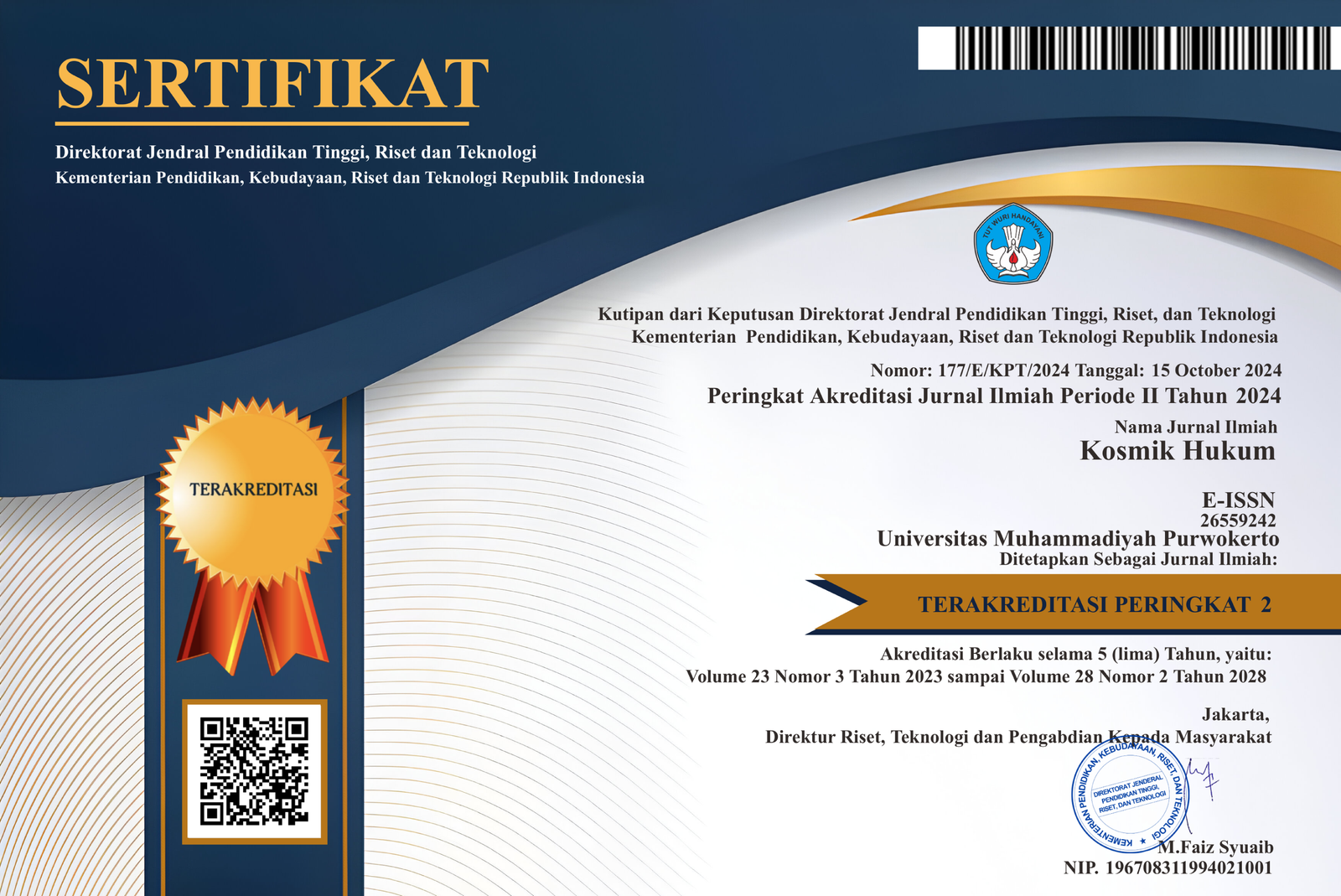
sertifikat