Abstract
Workers perceive that several new provisions regarding Fixed-Term Employment Agreements are detrimental to their rights. According to research findings, an agreement is considered valid if it meets the provisions stipulated in Article 1320 of the Civil Code. The requirements for a valid agreement are regulated in Article 1320 of the Civil Code. Article 1 Paragraph (14) of Law Number 13 of 2003 concerning employment, an employment agreement is: "An agreement between workers/laborers and employers or employers containing work conditions, rights and obligations of the parties." Employment agreements are divided into Fixed-Term Employment agreements and permanent employment agreements. The provisions regarding employment agreements made in writing have been regulated in Article 54, paragraph 1 of Law Number 13 of 2003 on Manpower. The provisions, nature, and type of work for a fixed-term employment agreement can be seen in Article 59. Changes in the duration of Fixed-Term Employment Agreements are regulated in Article 59, Paragraph (4) of the Manpower Law, which states that a Fixed-Term Employment Agreement can be made for a maximum period of two years and may be extended only once for a maximum period of one year. This means that if an employer applies a renewal system, the maximum duration for a Fixed-Term Employment Agreement is four years. However, in Article 81, Number 12 of the Job Creation Law, which amends Article 56 of the Manpower Law, Paragraph (3) stipulates that the employment contract determines the duration of a Fixed-Term Employment Agreement. Article 59 of the Job Creation Law eliminates the specific duration requirement for Fixed-Term Employment Agreements.
There is no Figure or data content available for this article
References
Ahmad Jaya Kusuma, Edith Ratna M.S., Irawati, “Kedudukan Hukum Pekerja Pkwt Yang Tidak Sesuai Dengan Ketentuan Undang-Undang Ketenagakerjaan”, Jurnal NOTARIUS, Volume 13 Nomor 1 Tahun 2020.
Fithriatus Shalihah, ‘Implementasi Perjanjian Kerja Waktu Tertentu (PKWT) Dalam Hubungan Kerja Di Indonesia’, Jurnal Selat, 4.1 (2016), 70–100.
Suhartoyo, “Perlindungan Hukum Bagi Buruh Dalam Sistem Hukum Ketenagakerjaan Nasional”, Jurnal Administrative Law & Governance Journal, Vol. 2 No. 2 Tahun 2019, halaman 326–36.
Rosifany, Ony. "Perlindungan Hukum Terhadap Pekerja Perempuan Menurut Ketentuan Undang-Undang Ketenagakerjaan." LEGALITAS: Jurnal Ilmiah Ilmu Hukum, Vol. 4, No. 2 Tahun 2020, halaman 36-53.
Ida Hanifah & Ismail Koto, “Problema Hukum Seputar Tunjangan Hari Raya Di Masa Pandemi COVID-19”, Jurnal Yuridis 8, No. 1, (2021): p. 23-42.
Rahimah & Ismail Koto, “Implications of Parenting Patterns in the Development of Early Childhood Social Attitudes”. IJRS: International Journal Reglement & Society 3, No. 2, (2022): p.129-133.
Zainuddin, Rahmat Ramadhani, “The Legal Force Of Electronic Signaturesin Online Mortgage Registration”, Jurnal Penelitian Hukum De Jure 21, No. 2, (2021): p. 244
How to Cite This
Article Metrics
Download Statistics
Other Statistics

Copyright and Permissions

This work is licensed under a Creative Commons Attribution 4.0 International License.
Authors who publish with Kosmik Hukum agree to the following terms:
- Authors retain copyright and grant the journal right of first publication with the work simultaneously licensed under a Creative Commons Attribution License (CC BY) that allows others to share the work with an acknowledgment of the work's authorship and initial publication in this journal.
- Authors are able to enter into separate, additional contractual arrangements for the non-exclusive distribution of the journal's published version of the work (e.g., post it to an institutional repository or publish it in a book), with an acknowledgment of its initial publication in this journal.
- Authors are permitted and encouraged to post their work online (e.g., in institutional repositories or on their website) prior to and during the submission process, as it can lead to productive exchanges, as well as earlier and greater citation of published work.
Data Availability
template

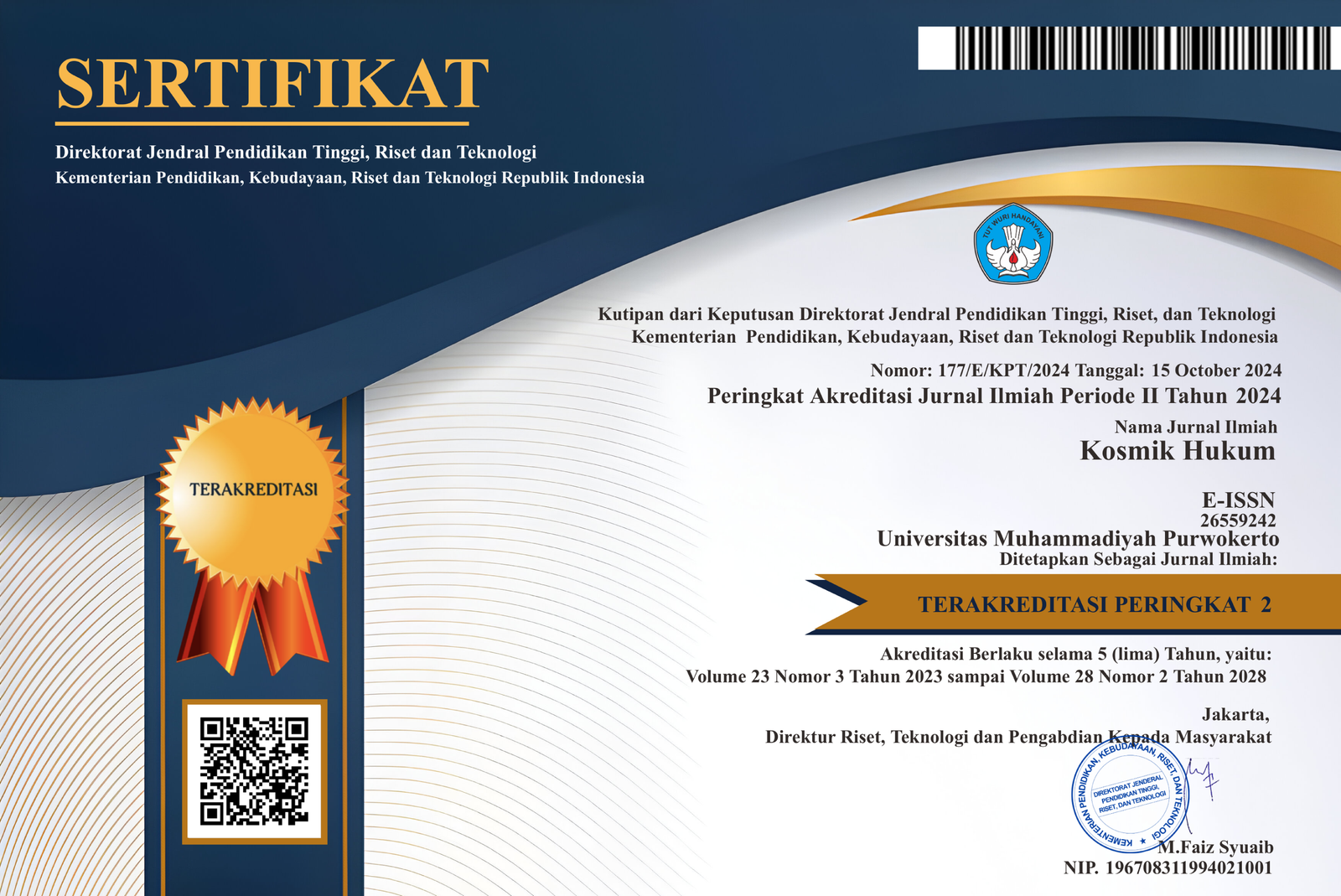
sertifikat