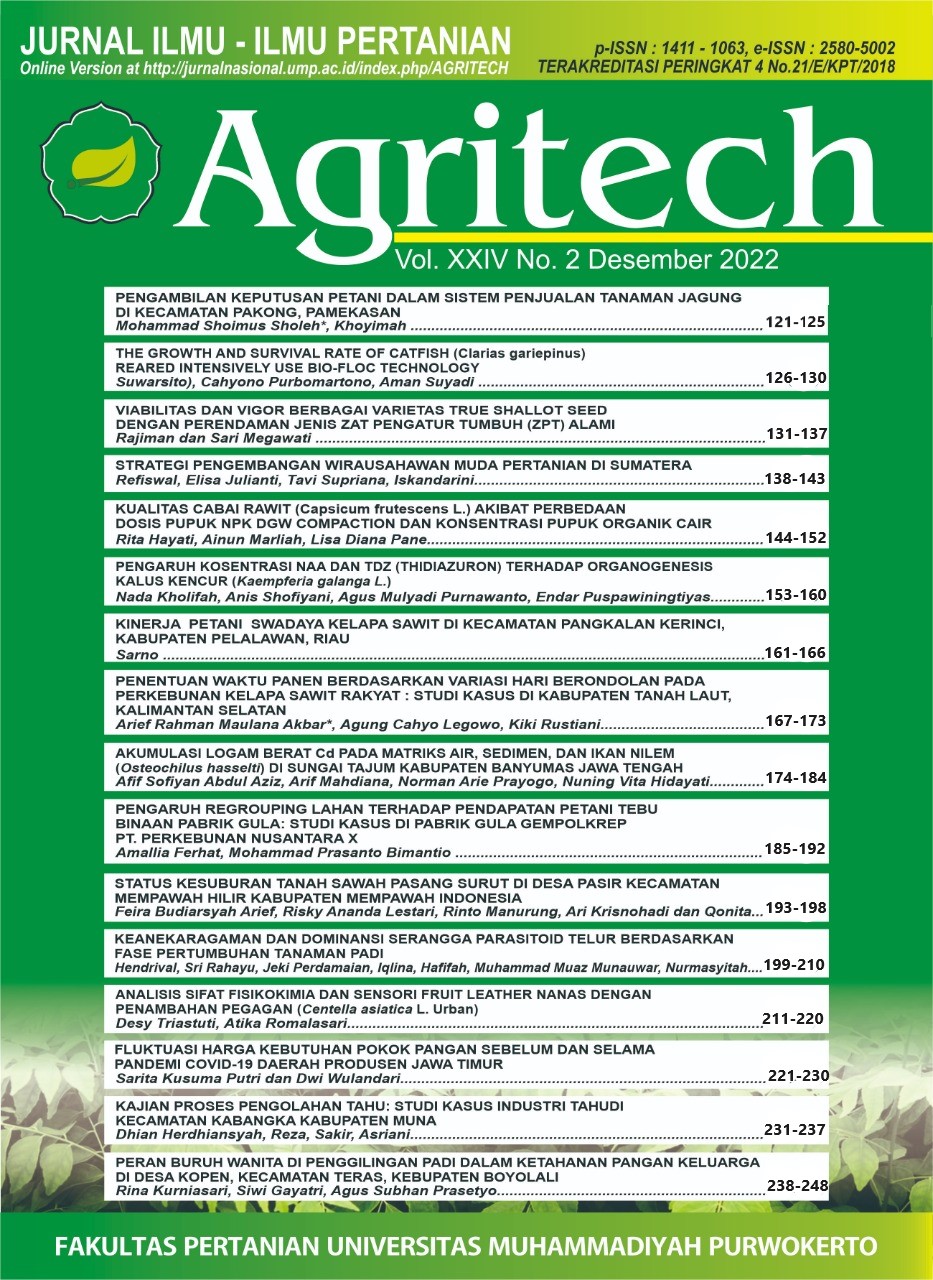
THE GROWTH AND SURVIVAL RATE OF CATFISH (Clarias gariepinus) REARED INTENSIVELY USE BIO-FLOC TECHNOLOGY
DOI:
https://doi.org/10.30595/agritech.v24i2.13420Keywords:
bio-floc technology, Clarias gariepinus, growth, survival rateAbstract
The study purposed to investigate the growth and survival rate of catfish (Clarias gariepinus) reared intensively use bio-floc technology. The research used an experimental method, consists of two treatments. Treatment A was catfish reared uses Noni fruit (Morinda citrifolia) fermentation on culture media every seven days with a dose of 10 ml/liter. The treatment also uses papaya leaves as additional feed. Treatment B was catfish reared apply bio-floc technology use probiotics. Probiotic consists of Lactobacillus spp. and Thiobacillus spp. The addition of 5 grams of Lactobacillus spp. and 500 ml molasses in rearing media were carried out every seven days. The feed used in the experiment was fermented by Thiobacillus spp. and molasses at a dose of 150 ml/kg of feed. Two plastic tanks with a volume of 5000 L were used in the experiments. Amount 3000 catfish with the average initial body weight of 6 grams reared in each plastic tank. Catfish were fed twice daily with a feeding rate of 7%. Feed nutrition content was protein minimum 28%, fat maximum 4%, and fiber maximum 5%. Catfish were reared for 64 days. The research data consist of fish growth, feed conversion ratio, and survival rate of fish. Data were analyzed quantitatively descriptively. The results showed that survival rate of catfish in treatment B higher than treatment A, but growth of catfish in treatment B lower than treatment A. Feed conversion ratio in treatment A lower than treatment B. The specific growth rate, feed conversion ratio, and survival rate of catfish in treatment A were 5.19%, 69.83%, and 0.78, respectively. At the same time, the specific growth rate, feed conversion ratio, and survival rate of catfish in treatment B were 3.89%, 90.80%, and 0.95, respectively. The results were indicated that bio-floc technology could improve the survival rate of catfish but no increased growth of catfish.References
Avnimelech, Y. (1999). Carbon/nitrogen ratio as a control element in aquaculture systems. Aquaculture, Vol. 176: 227–235.
Crab, R., Defoirdt, T., Bossier, P., & Verstraete, W. (2012). Biofloc technology in aquaculture: Beneficial effects and future challenges. Aquaculture, Vol. 356–357: 351–356.
Craig, S., Helfrich, L. A., Kuhn, D., & Schwarz, M. H. (2017). Understanding fish nutrition, feeds, and feeding. Virginia Cooperative Extension.
De Schryver, P., Crab, R., Defoirdt, T., Boon, N., & Verstraete, W. (2008). The basics of bio-flocs technology: The added value for aquaculture. Aquaculture, Vol. 277 (3–4), 125–137.
Dvimurti, N. (2013). Pengaruh Pemberian Pakan Alami Bioflok sebagai Upaya Pencegahan Infeksi Aeromonas hydrophila pada Benih Ikan Mas Koki. Universitas Padjadjaran.
Effendi, M. I. (2002). Biologi Perikanan. Yayasan Pustaka Nusatama.
Ekasari, J. (2009). Teknologi Bioflok: Teori dan Aplikasi dalam Perikanan Budidaya Sistem Intensif Bioflocs Technology: Theory and Application in Intensive Aquaculture System. Jurnal Akuakultur Indonesia, Vol. 8 (2): 117–126.
Hermawan, T. E. S. A., Sudaryono, A., & Prayitno, S. B. (2014). Pengaruh padat tebar berbeda terhadap pertumbuhan dan kelulushidupan benih lele (Clarias gariepinus) dalam media bioflok. Journal of Aquaculture Management and Technology, Vol. 3 (3): 35–42.
Isnawati, N., Sidik, R., & Mahasri, G. (2015). Potensi Serbuk Daun Pepaya Untuk Meningkatkan Efisiensi Pemanfaatan Pakan, Rasio Efisiensi Protein dan Laju Pertumbuhan Relatif Pada Budidaya Ikan Nila (Oreochromis Niloticus) Papaya Leaf Powder Potential to Improve Efficiency Utilization of Feed, Protein. Jurnal Ilmiah Perikanan dan Kelautan Vol, 7(2): 121-124.
NRC. (1977). Nutrient requirements of warm water fishes. National Academic Press.
Setiawan, A., Ariqoh, R., Tivani, P., Pipih, L., & Pudjiastuti, I. (2016). “Bioflokulasi Sistem” Teknologi Budidaya Lele Tebar Padat Tinggi Dengan Kapasitas 1m3/750 Ekor Dengan Flock Forming Bacteria. Inovasi Teknik Kimia, Vol. 1 (1): 45–49.
Sudana, O. A. A. K., Setiawan, A., & Pratama, I. P. A. E. (2016). Augmented Reality for Chemical Elements: Periodic AR. Journal of Theoretical and Applied Information Technology (JATIT), Vol. 90 (1): 88–92.
Suwarsito, S., & Mustafidah, H. (2015). Determination of Feed Fish Price Based on Feed Formulation with Local Raw Materials using Fuzzy Logic Implementation. International Journal of Fisheries and Aquatic Studies (IJFAS), Vol. 3 (2): 1–5.
Suwarsito, S., & Mustafidah, H. (2018). Determination of Appropriate Fish Culture Method Based on Water Quality Using Expert System. Advanced Science Letters, Vol. 24(12): 9178–9181.
Wahjuningrum, D., & Setiawati, M. (2009). Optimasi Budidaya Super-Intensif Ikan Nila Ramah Lingkungan: Dinamika Mikroba Bioflok. IPB (Bogor Agricultural University).
Weatherley, A. H. (1972). Growth and ecology of fish population. Academic Press.
Zonneveld, N. E., Husman, A., & Boon, J. H. (1991). Prinsip-prinsip Budidaya Ikan. PT. Gramedia Pustaka Utama.
Downloads
Published
Issue
Section
License
Authors who publish with this journal agree to the following terms:
Authors retain copyright and grant the journal right of first publication with the work simultaneously licensed under a Creative Commons Attribution 4.0 International License that allows others to share the work with an acknowledgement of the work's authorship and initial publication in this journal.
Authors are able to enter into separate, additional contractual arrangements for the non-exclusive distribution of the journal's published version of the work (e.g., post it to an institutional repository or publish it in a book), with an acknowledgement of its initial publication in this journal.
Authors are permitted and encouraged to post their work online (e.g., in institutional repositories or on their website) prior to and during the submission process, as it can lead to productive exchanges, as well as earlier and greater citation of published work (See The Effect of Open Access).

This work is licensed under a Creative Commons Attribution 4.0 International License.