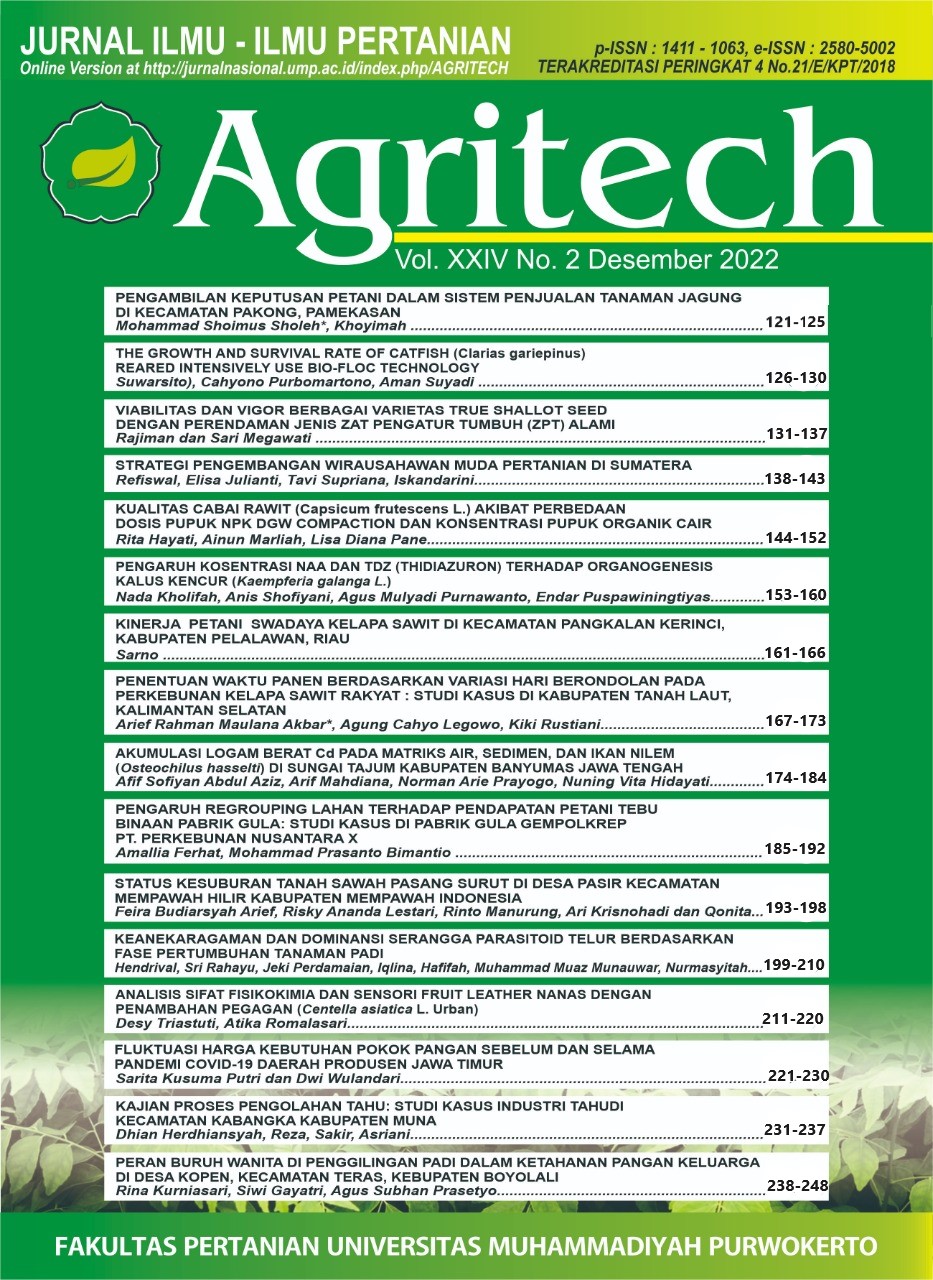
VIABILITAS DAN VIGOR BERBAGAI VARIETAS TRUE SHALLOT SEED DENGAN PERENDAMAN JENIS ZAT PENGATUR TUMBUH (ZPT) ALAMI
DOI:
https://doi.org/10.30595/agritech.v24i2.14126Abstract
One of the keys to successful shallot cultivation with True Seed of Shallot (TSS) is determined by viability and vigor at the nursery. The aim of the study was to determine the effect of varieties and types of natural Plant Growth Regulatory (PGR) on germination and TSS vigor index. The study was conducted at the Seed Technology Laboratory of the Agricultural Development Polytechnic of Yogyakarta Magelang in July 2021 using a factorial Completely Randomized Design (CRD). The first factor is shallot variety (V) consisting of 3 levels: V1 = Sanren, V2 = Maserati, and V3 = Lokananta. The second factor is Types of Natural plant Growth Regulators (Z) consisting of 4 types: Z0 = aquadest, Z1 = Shallot Extract, Z2 = bean sprout extract, and Z3 = young coconut water. Each treatment was repeated 3 times. Parameters observed were germination, growth speed and vigor index. Data analysis was carried out using a variance test (F test) and Duncan's multiple distance test (DMRT) with a level of 0.05. The results showed that the TSS variety significantly affected germination and growth speed. The type of natural PGR did not significantly affect the germination, but it did affect the growth speed. TSS varieties and natural PGR types significantly interacted with the vigor index parameter. The best vigor index was achieved when the Lokananta variety was treated with distilled water.
Â
Keywords: Shallot, bean sprouts, coconut water, germination, vigor.
Downloads
Published
Issue
Section
License
Authors who publish with this journal agree to the following terms:
Authors retain copyright and grant the journal right of first publication with the work simultaneously licensed under a Creative Commons Attribution 4.0 International License that allows others to share the work with an acknowledgement of the work's authorship and initial publication in this journal.
Authors are able to enter into separate, additional contractual arrangements for the non-exclusive distribution of the journal's published version of the work (e.g., post it to an institutional repository or publish it in a book), with an acknowledgement of its initial publication in this journal.
Authors are permitted and encouraged to post their work online (e.g., in institutional repositories or on their website) prior to and during the submission process, as it can lead to productive exchanges, as well as earlier and greater citation of published work (See The Effect of Open Access).

This work is licensed under a Creative Commons Attribution 4.0 International License.