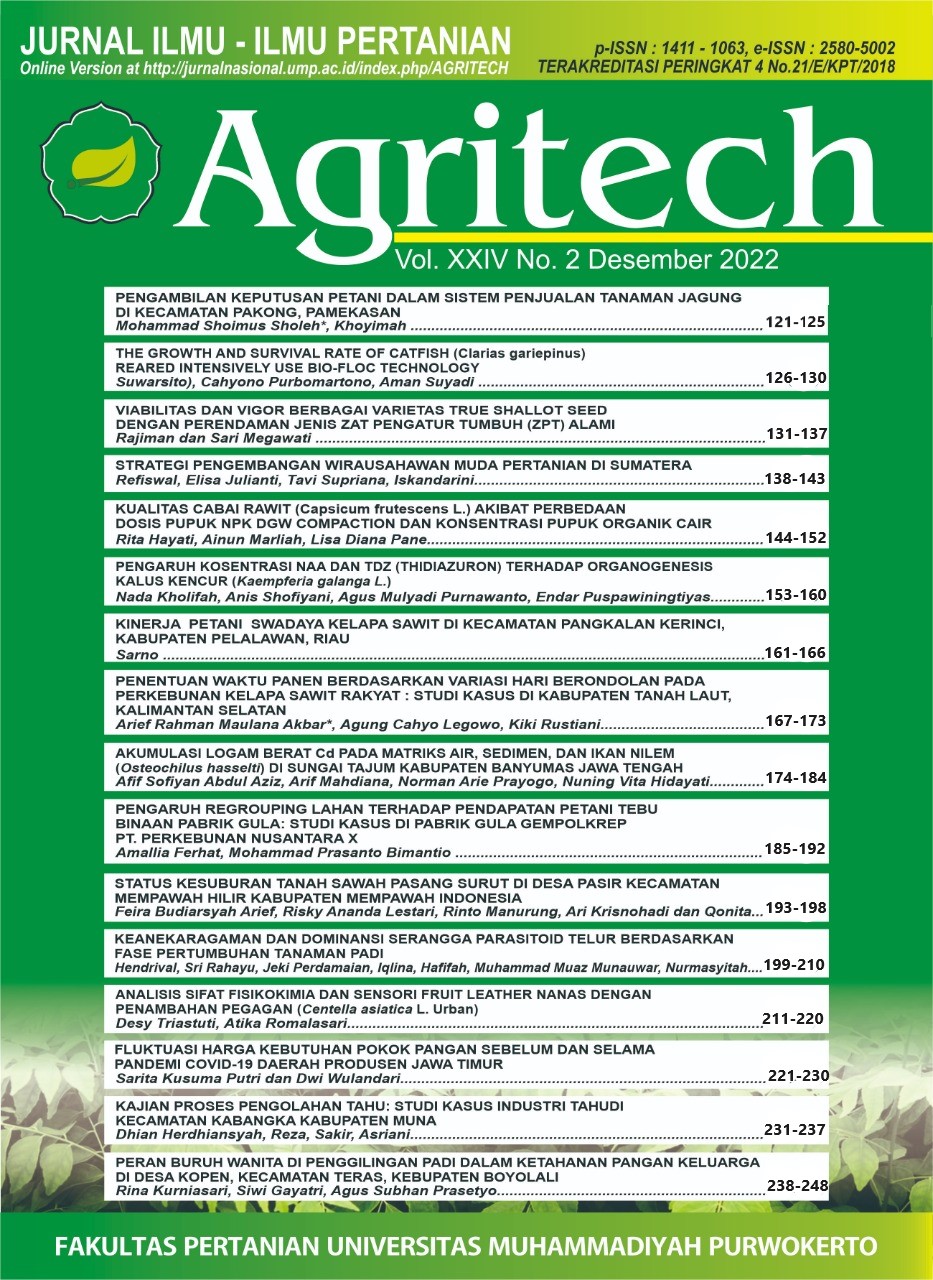
ANALISIS SIFAT FISIKOKIMIA DAN SENSORI FRUIT LEATHER NANAS DENGAN PENAMBAHAN PEGAGAN (Centella asiatica L. Urban)
DOI:
https://doi.org/10.30595/agritech.v24i2.15738Keywords:
Centella asiatica, Fruit leather, Pectin, PineappleAbstract
 Fruit leather is a processed food product in the form of thin sheets made from fruit and through a drying process. Pineapple is a tropical fruit that is popular among the public, but it is perishable. In this study, gotu kola (Centella asiatica) and pectin were added to increase the nutritional content and health benefits of fruit leather. The purpose of the study was to determine the effect of the addition of gotu kola and pectin on the physicochemical and sensory properties of pineapple fruit leather and to find out the best concentration of gotu kola and pectin addition in making pineapple fruit leather based on these physicochemical and sensory properties. The study used a Complete Randomized Design (CRD) with factor the addition of gotu kola concentrations and factor the addition of pectin. Observations were made on physicochemical properties including thickness, water content, Aw, pH, vitamin C, and color, as well as sensory properties, towards the color, taste, aroma, and texture of fruit leather. The data from the study were analyzed statistically with ANOVA and DMRT at a significance level of 5%. The results showed that the addition of gotu kola and pectin and the interaction of the two did not affect the water content, Aw, vitamin C, and the degree of redness (a), but the addition of gotu kola affected the pH value, brightness (L), yellowish degree (b), and sensory value of pineapple fruit leather. The best treatment was C1P1 with a water content of 20.31%, an Aw value of 0.56, a pH value of 4.21, a vitamin C content of 23.65 mg / 100 g, a brightness (L) of 50.63, a degree of redness (a) of 4.66, a degree of yellowness (b), and sensory favored by the panelists.
Downloads
Published
Issue
Section
License
Authors who publish with this journal agree to the following terms:
Authors retain copyright and grant the journal right of first publication with the work simultaneously licensed under a Creative Commons Attribution 4.0 International License that allows others to share the work with an acknowledgement of the work's authorship and initial publication in this journal.
Authors are able to enter into separate, additional contractual arrangements for the non-exclusive distribution of the journal's published version of the work (e.g., post it to an institutional repository or publish it in a book), with an acknowledgement of its initial publication in this journal.
Authors are permitted and encouraged to post their work online (e.g., in institutional repositories or on their website) prior to and during the submission process, as it can lead to productive exchanges, as well as earlier and greater citation of published work (See The Effect of Open Access).

This work is licensed under a Creative Commons Attribution 4.0 International License.