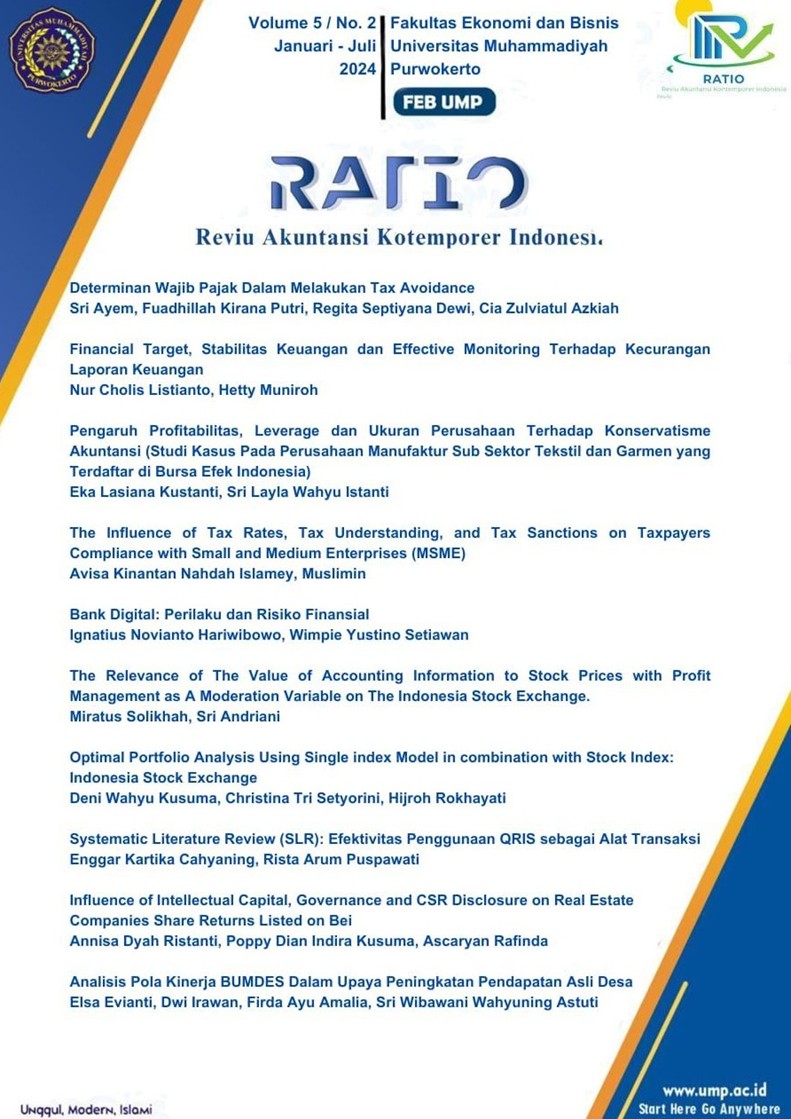
Optimal Portfolio Analysis Using Single index Model In combination with Stock Index: Indonesia Stock Exchange
DOI:
https://doi.org/10.30595/ratio.v5i2.21702Keywords:
Optimal Portfolio; Single Index ModelAbstract
This study aims to determine the best optimal portfolio formation method using a single index model calculation on the Indonesia Stock Exchange. This research uses 3 listed stock indices namely IDX30, IDXHIDIV20, and SRI-KEHATI. This research is descriptive quantitative with data collection techniques in the form of literature studies by studying journals, books and literature that have relevance to research. The sample of this study was obtained using purposive sampling technique with criteria that have been considered by the researcher. The type of data used is secondary data. This study uses two stages in analyzing the formation of the optimal portfolio, namely partial analysis on each index and in combination using the three stock indices. The results showed that the simulation of optimal portfolio formation with the highest return was obtained when the analysis was carried out jointly on the three stock indices with a value of 9.07%.
References
Anggraeni, R. W., & Mispiyanti. (2020). Analisis pembentukan portofolio optimal saham dengan menggunakan model indeks tunggal (studi kasus pada perusahaan terdaftar di indeks SriKehati periode 2016-2018). Jurnal Ilmiah Mahasiswa Manajemen, Bisnis Dan Akuntansi, 2(1), 47–54.
Arifin, N. R., Nugroho, T., & Sukmana, R. (2019). Pemilihan saham syariah yang efisien untuk pembentukan portofolio optimal. Jurnal Ilmiah Ekonomi Islam, 5(3), 207–316. https://doi.org/10.29040/jiei.v5i3.643
Febrianti, S., Marjono, & Apriani, T. (2021). Pembentukan portofolio optimal saham syariah yang terdaftar di JII dengan metode single index model. Jurnal Ilmiah Ekonomi Islam, 7(03), 1895–1904. https://doi.org/10.29040/jiei.v7i3.3208
Haikal, M. C., Nurmalasari, N., & Faujiah, N. H. (2023). Portofolio optimal dengan model indeks tunggal pada industri manufaktur. Tahta Media Group.
Hartono, J. (2014). Teori dan praktik portofolio dengan Excel. Salemba Empat.
Iryani. (2019). Analisis portofolio optimal pada saham LQ 45 periode 2017-2018. AkMen, 16(4), 493–503. https://e-jurnal.stienobel-indonesia.ac.id/index.php/akmen
Jogiyanto. (2017). Teori portofolio dan analisis investasi (11th ed.). BPPE Yogyakarta.
Nugroho, H. S. (2020). Portofolio optimal saham menggunakan model indeks tunggal studi empirik pada saham-saham Jakarta Islamic Index (JII) periode 2014-2018. Jurnal Riset Akuntansi Dan Manajemen, 9(1), 44–51.
Pratama, L. A. (2019). Analisis pembentukan portofolio saham optimal menggunakan metode single index model. Jurnal Ilmu Manajemen, 16(1). www.idx.co.id
Rosa, S. N., Tereza, L., Agustina, E., Desilfa, Y., & Sari, D. P. P. (2023). Formation of optimal portfolio using a single index in pharmaceutical companies in 2019-2020. Research in Accounting Journal, 3(1). http://journal.yrpipku.com/index.php/raj
Sugiyono. (2019). Metode penelitian bisnis. Alfabeta.
Tandelilin, E. (2017). Manajemen portofolio & investasi. Kanisius.
Downloads
Published
How to Cite
Issue
Section
License
Copyright (c) 2024 Deni Wahyu Kusuma

This work is licensed under a Creative Commons Attribution 4.0 International License.
Authors who publish with this journal agree to the following terms:
Authors retain copyright and grant the journal right of first publication with the work simultaneously licensed under a Creative Commons Attribution License that allows others to share the work with an acknowledgement of the work's authorship and initial publication in this journal.
Authors are able to enter into separate, additional contractual arrangements for the non-exclusive distribution of the journal's published version of the work (e.g., post it to an institutional repository or publish it in a book), with an acknowledgement of its initial publication in this journal.
Authors are permitted and encouraged to post their work online (e.g., in institutional repositories or on their website) prior to and during the submission process, as it can lead to productive exchanges, as well as earlier and greater citation of published work (See The Effect of Open Access).

RATIO : Reviu Akuntansi Kontemporer Indonesia is licensed under a Creative Commons Attribution 4.0 International License.



_001.png)