The correlation between bullying and mental-emotional disorders among adolescents in Pekalongan city

Downloads
Background: Adolescence is a critical developmental period characterized by increased vulnerability to mental health disorders, particularly in response to psychosocial stressors such as bullying. In Indonesia, the incidence of adolescent mental-emotional disorders and bullying is rising. While international studies have established a link between bullying and mental health, research in specific local contexts remains limited.
Purpose: This study aims to examine the correlation between bullying and emotional mental disorders among adolescents in Pekalongan City.
Methods: This research employed a cross-sectional study conducted between October and November 2024, involving 360 high school students aged 15–18 years, selected through proportional random sampling from a population of 3,080. Bullying was measured using the Forms of Bullying Scale–Victimization (FBS-V), while emotional and mental disorders were assessed using the Strengths and Difficulties Questionnaire (SDQ). The data were analyzed using Spearman's rank correlation test.
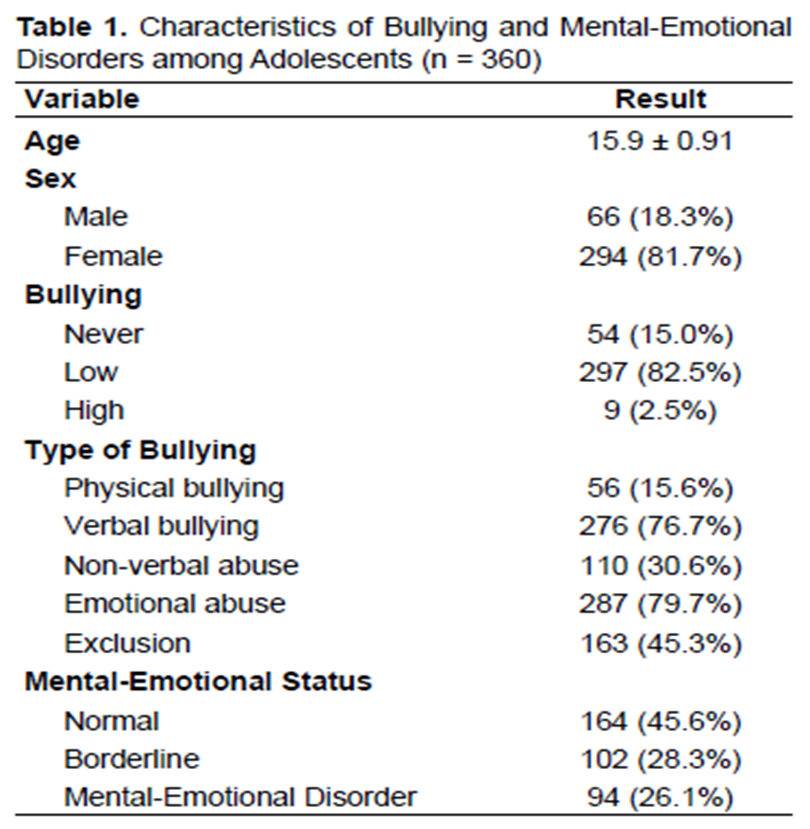
Results: The study found that 85% of respondents had experienced bullying, predominantly in the low category (82.5%). Additionally, 26.1% of students were identified as having emotional mental disorders. Statistical analysis revealed a significant positive correlation between bullying and emotional mental disorders (Spearman's rho = 0.470, p < 0.001), indicating moderate correlation strength.
Conclusions: Bullying is positively associated with emotional and mental disorders among adolescents in Pekalongan City.
Copyright (c) 2025 MEDISAINS

This work is licensed under a Creative Commons Attribution-NonCommercial 4.0 International License.
Authors who publish with this journal agree to the following terms:Authors retain copyright and grant the journal right of first publication with the work simultaneously licensed under a Creative Commons Attribution-NonCommercial 4.0 International License that allows others to share the work with an acknowledgement of the work's authorship and initial publication in this journal.
Authors are able to enter into separate, additional contractual arrangements for the non-exclusive distribution of the journal's published version of the work (e.g., post it to an institutional repository or publish it in a book), with an acknowledgement of its initial publication in this journal.
Authors are permitted and encouraged to post their work online (e.g., in institutional repositories or on their website) prior to and during the submission process, as it can lead to productive exchanges, as well as earlier and greater citation of published work (See The Effect of Open Access).
This work is licensed under a Creative Commons Attribution-NonCommercial 4.0 International License.