In vivo study of Centella asiatica leaf extract cream for Matrix Metalloproteinase-1 inhibition and collagen enhancement to prevent photoaging

Downloads
Background: Ultraviolet B (UVB) exposure accelerates skin aging, causing wrinkles and increasing matrix metalloproteinase-1 (MMP-1) activity, which degrades collagen. Centella asiatica (CA) has well-documented anti-inflammatory and antioxidant properties that may counteract UVB-induced photoaging. However, studies on its topical formulation for MMP-1 inhibition and collagen enhancement remain limited.
Purpose: This study aims to determine the effect of CA leaf extract cream on inhibiting MMP-1 and increasing collagen in skin tissue exposed to UVB rays.
Methods: This experimental study used a post-test only control group design. The sample population of BALB/c mice was 24, divided into four groups: healthy control group (KN), negative control group (K-), Treatment 1 (P1): 10% CA extract cream dosage, and Treatment 2 (P2): 20% CA extract cream dosage. Skin tissue samples were measured for MMP-1 expression using immunohistochemistry (IHC) staining, and collagen density using Sirius Red staining. Data analysis on MMP-1 expression using One-way ANOVA test and collagen density using Kruskal Wallis test.
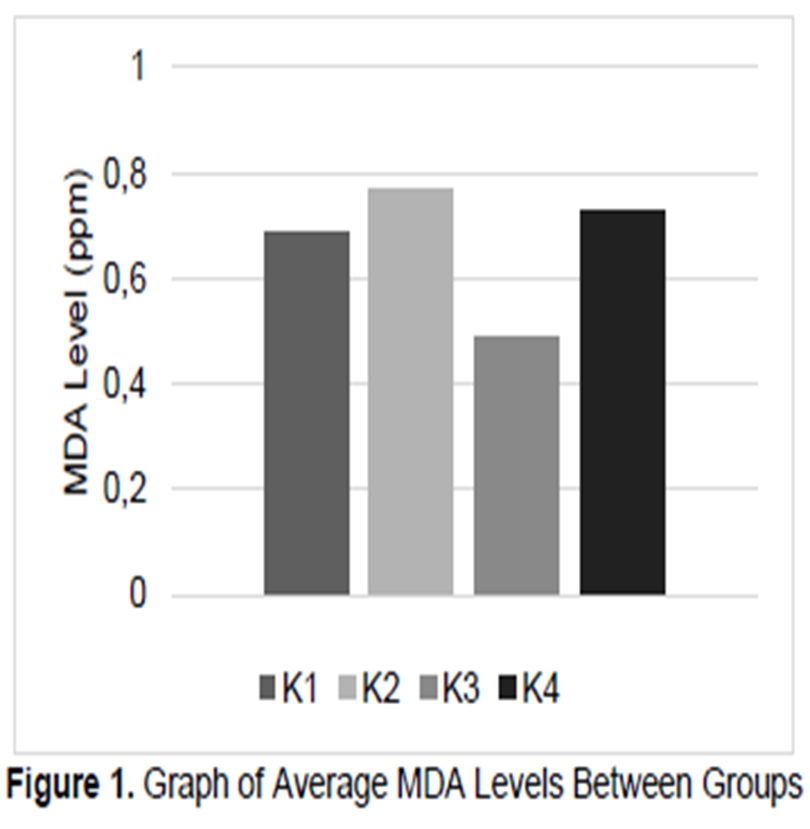
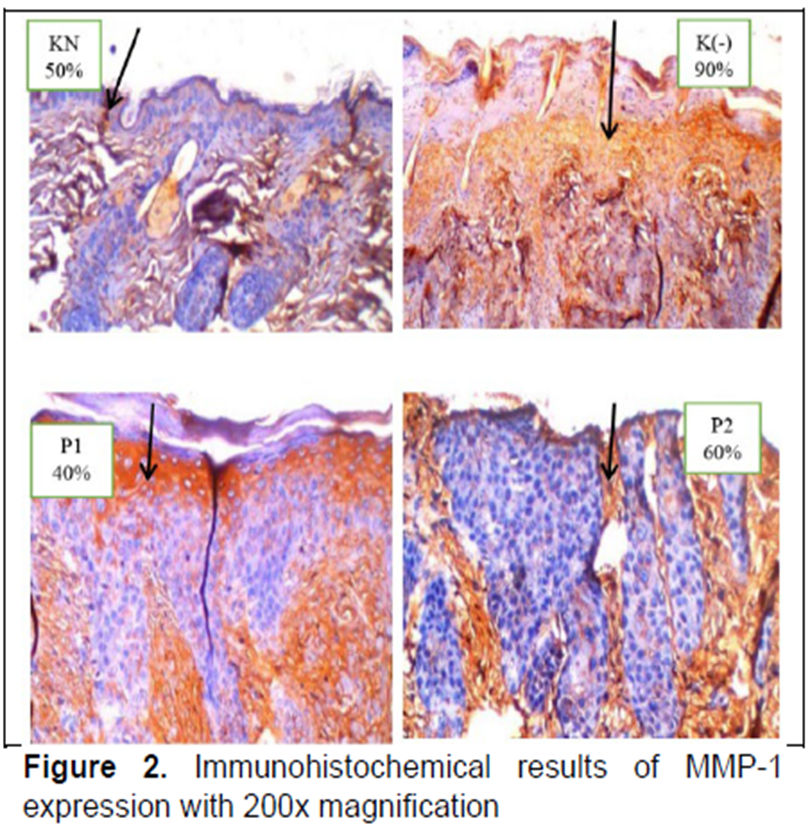
Results: MMP-1 expression was highest in the K2 group (UVB exposure + cream base) and decreased in the P1 and P2 groups (10% CA cream), with the lowest expression in the K1 group (healthy control). However, One-Way ANOVA showed no significant differences among groups (p=0.053). Collagen density analysis using the Kruskal-Wallis test showed significant differences (p = 0.04), with a decrease in the K2 group and an increase in the K3 and K4 groups.
Conclusion: Application of CA extract cream affects MMP-1 expression and collagen density in skin tissue exposed to UVB rays.
Copyright (c) 2025 MEDISAINS

This work is licensed under a Creative Commons Attribution-NonCommercial 4.0 International License.
Authors who publish with this journal agree to the following terms:Authors retain copyright and grant the journal right of first publication with the work simultaneously licensed under a Creative Commons Attribution-NonCommercial 4.0 International License that allows others to share the work with an acknowledgement of the work's authorship and initial publication in this journal.
Authors are able to enter into separate, additional contractual arrangements for the non-exclusive distribution of the journal's published version of the work (e.g., post it to an institutional repository or publish it in a book), with an acknowledgement of its initial publication in this journal.
Authors are permitted and encouraged to post their work online (e.g., in institutional repositories or on their website) prior to and during the submission process, as it can lead to productive exchanges, as well as earlier and greater citation of published work (See The Effect of Open Access).
This work is licensed under a Creative Commons Attribution-NonCommercial 4.0 International License.