Herbal combination therapy of coriander and red ginger extracts to improve hematological profiles in hyperlipidemia: in vivo study

Downloads
Background: Herbal therapies offer promising alternatives for managing hyperlipidemia-induced hematological disorders. This study focuses on the combined effects of Coriandrum sativum L. (coriander) and Zingiber officinale var. rubrum (red ginger) extracts on hematological profiles in hyperlipidemic conditions. While prior studies mainly investigated these extracts individually, their combined therapeutic potential remains underexplored.
Objective: To evaluate the effects of coriander and red ginger extracts, individually and in combination, on erythrocyte count, hemoglobin level, and hematocrit in rats with induced hyperlipidemia.
Methods: An experimental pre-test–post-test control group design was conducted on male Rattus norvegicus. Hyperlipidemia was induced by a high-fat diet and 0.01% PTU for 15 days. Rats were divided into four groups: hyperlipidemia control, red ginger extract (875 mg/kgBW), coriander extract (900 mg/kgBW), and a 1:1 combination. Hematological parameters were measured on days 16 and 32. Data were analyzed using two-way ANOVA.
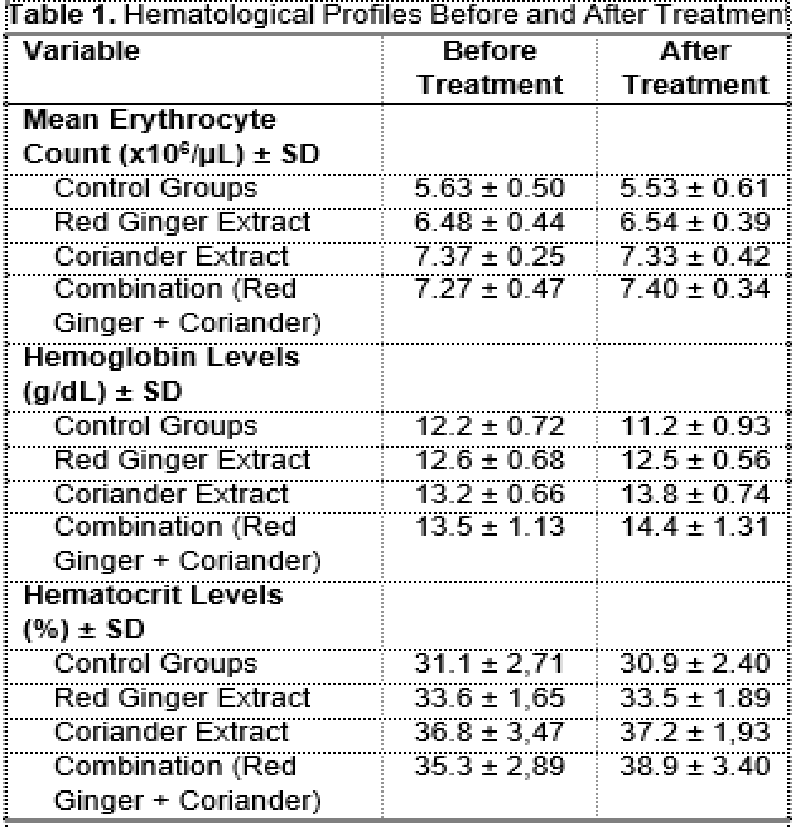
Results: Coriander and red ginger extracts significantly improved erythrocyte count, hemoglobin concentration, and hematocrit levels in hyperlipidemic rats (p = 0.000).
Conclusions: Combined administration of coriander and red ginger extracts effectively enhances hematological profiles in hyperlipidemia, supporting their potential as an alternative herbal therapy.

This work is licensed under a Creative Commons Attribution-NonCommercial 4.0 International License.
Authors who publish with this journal agree to the following terms:Authors retain copyright and grant the journal right of first publication with the work simultaneously licensed under a Creative Commons Attribution-NonCommercial 4.0 International License that allows others to share the work with an acknowledgement of the work's authorship and initial publication in this journal.
Authors are able to enter into separate, additional contractual arrangements for the non-exclusive distribution of the journal's published version of the work (e.g., post it to an institutional repository or publish it in a book), with an acknowledgement of its initial publication in this journal.
Authors are permitted and encouraged to post their work online (e.g., in institutional repositories or on their website) prior to and during the submission process, as it can lead to productive exchanges, as well as earlier and greater citation of published work (See The Effect of Open Access).
This work is licensed under a Creative Commons Attribution-NonCommercial 4.0 International License.