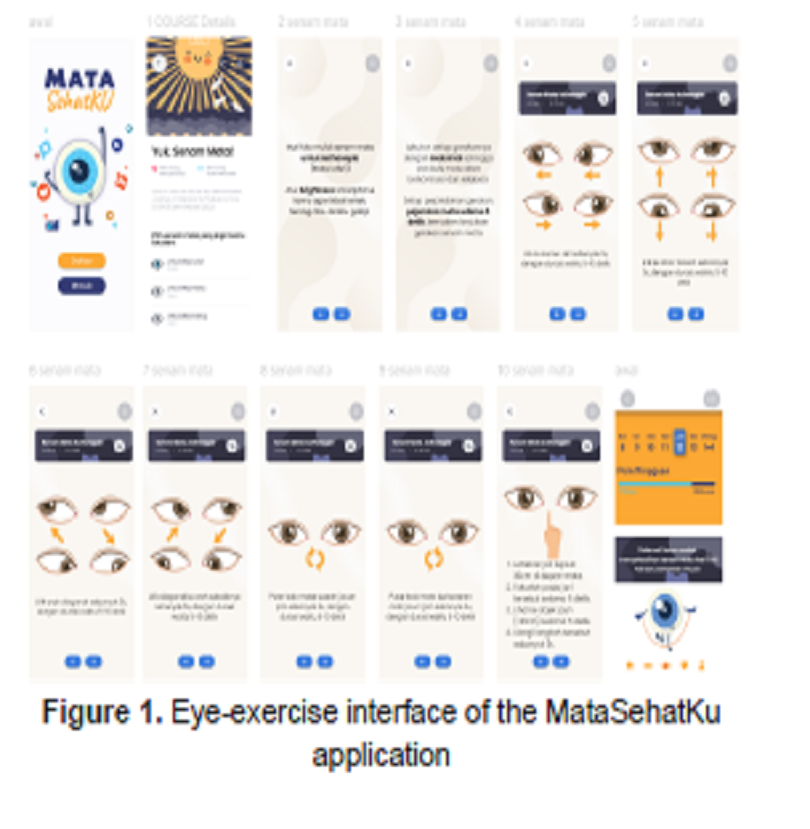
Mobile eye-exercise matasehatku application to reduce asthenopia in office workers: a quasi-experimental study

Downloads
Background: Asthenopia is common among computer users, yet limited evidence exists regarding interventions targeting office workers. Mobile health technologies offer new opportunities to promote ocular health in technology-intensive work environments.
Purpose: This study aimed to evaluate the effectiveness of the MataSehatKu mobile eye-exercise application in reducing asthenopia among office workers in the information technology sector.
Method: A quasi-experimental pre-test–post-test control group design was conducted with 39 office workers (17 intervention, 22 control) selected by purposive sampling. Asthenopia levels were measured using the Digital Eye Strain Questionnaire (DES-Q) before and after a two-week intervention.
Result: The intervention group showed a significant reduction in mean asthenopia scores (8.82 ± 5.13 to 2.71 ± 1.96; mean decrease = 6.11; p < 0.001), while the control group showed a significant increase (12.45 ± 9.10 to 19.82 ± 12.91; mean increase = 7.36; p < 0.001). Between-group post-test comparison revealed significantly lower scores in the intervention group (p < 0.001). Effect size analysis indicated a large impact (Cohen’s d = 1.57 within-group; d = 1.74 between-groups).
Conclusion: The MataSehatKu application effectively reduced asthenopia among office workers, supporting the potential of mobile health–based eye-exercise programs as scalable occupational health strategies.

This work is licensed under a Creative Commons Attribution-NonCommercial 4.0 International License.
Authors who publish with this journal agree to the following terms:Authors retain copyright and grant the journal right of first publication with the work simultaneously licensed under a Creative Commons Attribution-NonCommercial 4.0 International License that allows others to share the work with an acknowledgement of the work's authorship and initial publication in this journal.
Authors are able to enter into separate, additional contractual arrangements for the non-exclusive distribution of the journal's published version of the work (e.g., post it to an institutional repository or publish it in a book), with an acknowledgement of its initial publication in this journal.
Authors are permitted and encouraged to post their work online (e.g., in institutional repositories or on their website) prior to and during the submission process, as it can lead to productive exchanges, as well as earlier and greater citation of published work (See The Effect of Open Access).
This work is licensed under a Creative Commons Attribution-NonCommercial 4.0 International License.