Fatigue and psychosocial factors associated with self-concept in pediatric cancer patients

Downloads
Background: Childhood cancer is a chronic disease that requires intensive treatment, such as chemotherapy and radiotherapy. While effective, these treatments often cause various side effects, with fatigue being one of the most common complaints. Fatigue not only impacts the physical health but also significantly impairs the activities, social interactions, and self-concept of children with cancer.
Purpose: This study aimed to analyze the factors that influence the self-concept of children with cancer undergoing treatment at Dr. Moewardi Surakarta Regional Hospital.
Method: This study used a cross-sectional design. It was conducted at Dr. Moewardi Hospital Surakarta in March 2025, involving 90 children with cancer aged 8-18 years old, selected using consecutive sampling from a population of 907 children with cancer. The research instruments used a demographic data questionnaire, the PedsQL multidimensional fatigue scale (MFS), and the self-perception profile for children (SPPC). Data were analyzed using multiple linear regression.
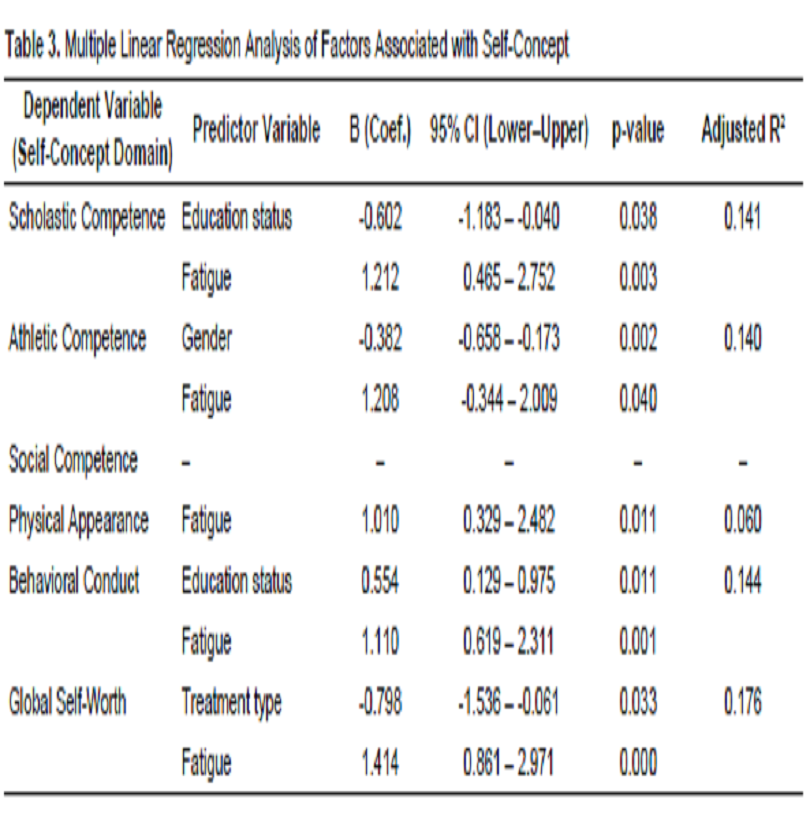
Results: The results of this study that fatigue is the most significant and consistent predictor of various dimensions of children's self-concept, even influencing nearly all subscales measured, including academic competence, athletic competence, physical appearance, and global self-esteem. Regression analysis corroborates this finding by showing that behavioral self-concept is significantly influenced by educational status and fatigue (p<0.001, R2 =0.165), while global self-esteem is influenced by type of care and fatigue (p<0.001, R2 =0.194). Although other factors such as educational status and gender are also associated with certain dimensions, fatigue is the only factor that universally and comprehensively influences nearly every aspect of children's self-concept.
Conclusions: Fatigue, child's educational status, gender, and type of treatment influence the self-concept of children with cancer.

This work is licensed under a Creative Commons Attribution-NonCommercial 4.0 International License.
Authors who publish with this journal agree to the following terms:Authors retain copyright and grant the journal right of first publication with the work simultaneously licensed under a Creative Commons Attribution-NonCommercial 4.0 International License that allows others to share the work with an acknowledgement of the work's authorship and initial publication in this journal.
Authors are able to enter into separate, additional contractual arrangements for the non-exclusive distribution of the journal's published version of the work (e.g., post it to an institutional repository or publish it in a book), with an acknowledgement of its initial publication in this journal.
Authors are permitted and encouraged to post their work online (e.g., in institutional repositories or on their website) prior to and during the submission process, as it can lead to productive exchanges, as well as earlier and greater citation of published work (See The Effect of Open Access).
This work is licensed under a Creative Commons Attribution-NonCommercial 4.0 International License.