Booklet-based menstrual hygiene education and its effect on knowledge and attitudes of women

Downloads
Background: Menstrual hygiene is a crucial aspect of reproductive health, particularly for women of reproductive age (WRA) in correctional institutions where access to health education is often limited.
Purpose: This study aimed to evaluate the effectiveness of booklet-based education in improving knowledge and attitudes of WRA regarding menstrual hygiene at the Women’s Correctional Facility in Pekanbaru City.
Method: A quasi-experimental one-group pretest–posttest design was conducted involving 70 respondents selected through purposive sampling. Data were collected using validated questionnaires and analyzed with the Wilcoxon Signed-Rank Test.
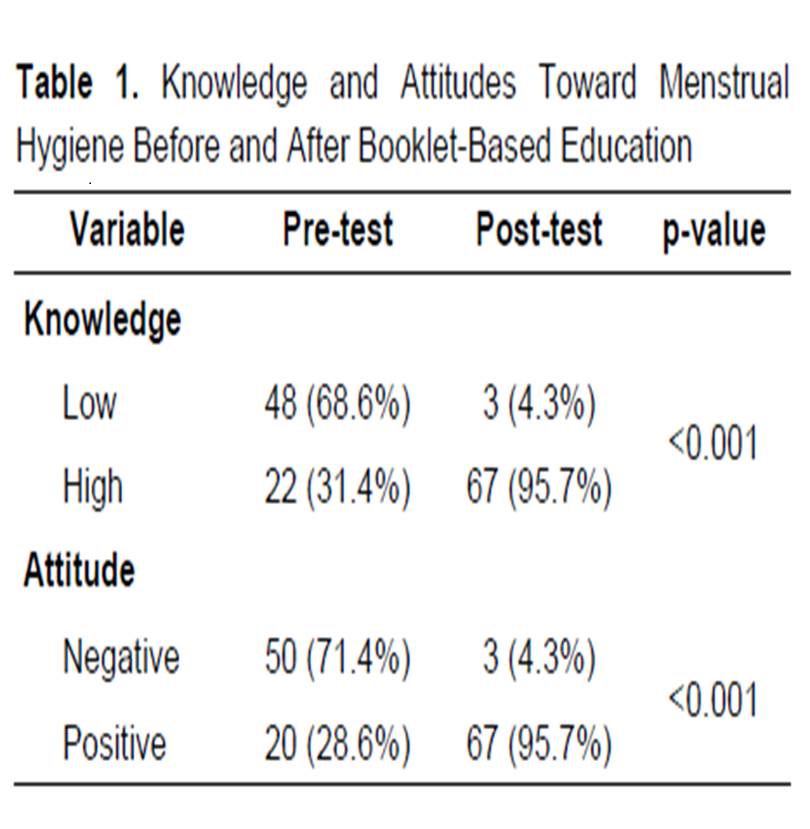
Results: Respondents’ knowledge increased from 68.6% to 95.7%, and positive attitudes from 71.4% to 95.7% after the intervention (p < 0.001).
Conclusion: Booklet-based education significantly improved menstrual hygiene knowledge and attitudes among incarcerated women, supporting its use as a sustainable and scalable reproductive health education strategy in correctional facilities.

This work is licensed under a Creative Commons Attribution-NonCommercial 4.0 International License.
Authors who publish with this journal agree to the following terms:Authors retain copyright and grant the journal right of first publication with the work simultaneously licensed under a Creative Commons Attribution-NonCommercial 4.0 International License that allows others to share the work with an acknowledgement of the work's authorship and initial publication in this journal.
Authors are able to enter into separate, additional contractual arrangements for the non-exclusive distribution of the journal's published version of the work (e.g., post it to an institutional repository or publish it in a book), with an acknowledgement of its initial publication in this journal.
Authors are permitted and encouraged to post their work online (e.g., in institutional repositories or on their website) prior to and during the submission process, as it can lead to productive exchanges, as well as earlier and greater citation of published work (See The Effect of Open Access).
This work is licensed under a Creative Commons Attribution-NonCommercial 4.0 International License.