Development and evaluation of a thoracic immobilization device for pediatric right lateral decubitus chest radiography in dengue hemorrhagic fever

Downloads
Background: Dengue hemorrhagic fever (DHF) remains a major health concern in hyperendemic regions such as Indonesia. Detecting plasma leakage—often indicated by pleural effusion—is essential for early severity assessment. The right lateral decubitus (RLD) chest X-ray is valuable for this purpose, yet obtaining artifact-free images in children is challenging due to movement and the absence of pediatric-specific immobilization tools.
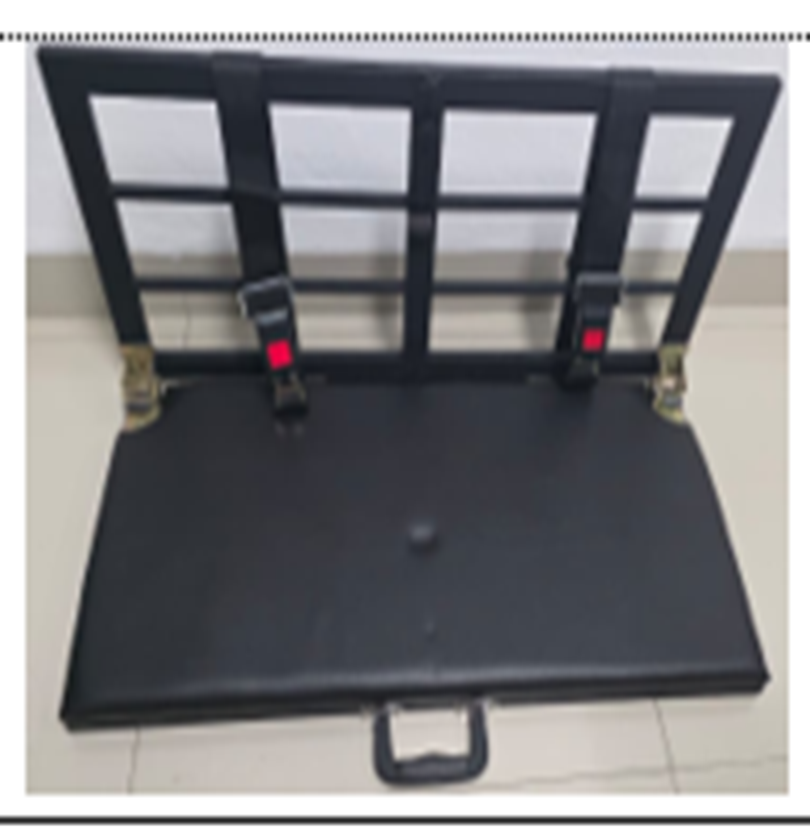
Purpose: To develop and evaluate a specialized immobilization device for pediatric RLD thoracic radiography to enhance image quality in the assessment of pleural effusion in suspected DHF cases.
Methods: This research and development study was conducted at a regional hospital in Jepara, Indonesia, from April to July 2025. The study included device design, expert validation, prototype refinement, and clinical performance evaluation using radiographer questionnaires.
Results: The device demonstrated high usability, with mean scores of 4.8 for flexibility, 4.7 for patient comfort, and 4.73 for ease of use. Importantly, its application produced RLD radiographs free of motion artifacts, enabling clearer visualization of pleural effusion.
Conclusion: The developed immobilization device effectively supports pediatric RLD chest radiography by improving positioning stability and eliminating motion artifacts. It has strong potential for routine clinical use in DHF assessment and may enhance diagnostic accuracy related to pleural effusion.

This work is licensed under a Creative Commons Attribution-NonCommercial 4.0 International License.
Authors who publish with this journal agree to the following terms:Authors retain copyright and grant the journal right of first publication with the work simultaneously licensed under a Creative Commons Attribution-NonCommercial 4.0 International License that allows others to share the work with an acknowledgement of the work's authorship and initial publication in this journal.
Authors are able to enter into separate, additional contractual arrangements for the non-exclusive distribution of the journal's published version of the work (e.g., post it to an institutional repository or publish it in a book), with an acknowledgement of its initial publication in this journal.
Authors are permitted and encouraged to post their work online (e.g., in institutional repositories or on their website) prior to and during the submission process, as it can lead to productive exchanges, as well as earlier and greater citation of published work (See The Effect of Open Access).
This work is licensed under a Creative Commons Attribution-NonCommercial 4.0 International License.