Pediatric sturge–weber syndrome diagnosed by computed tomography imaging in a resource-limited setting: a case report

Downloads
Background: Sturge–weber syndrome (SWS) is a rare neurocutaneous disorder marked by facial capillary malformations, leptomeningeal vascular anomalies, and ocular complications such as glaucoma. Diagnostic evaluation and management can be challenging in resource-limited settings where magnetic resonance imaging (MRI) and genetic testing are unavailable.
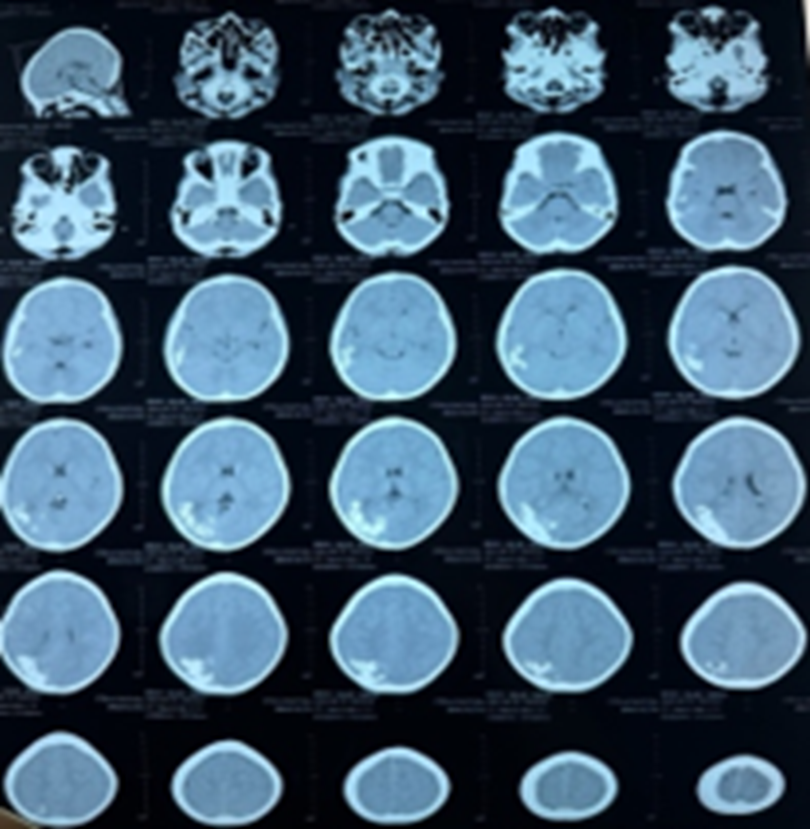
Case presentation: An 8-year-old girl presented with recurrent generalized tonic–clonic seizures. Examination revealed a unilateral port-wine stain involving the right trigeminal distribution and gingiva, along with decreased visual acuity and elevated intraocular pressure consistent with secondary glaucoma. Non-contrast head computed tomography (CT) showed gyriform cortical–subcortical calcifications with a tram-track appearance and right hemispheric atrophy, supporting the diagnosis of Sturge–Weber Syndrome. The patient was treated with valproic acid and topical timolol, resulting in good seizure control and improvement in ocular symptoms. She remains under regular pediatric and ophthalmologic follow-up.
Conclusions: This case demonstrates that clinical recognition combined with characteristic CT findings allows reliable diagnosis of SWS in the absence of MRI or genetic testing. Medical management provided favorable short-term outcomes, underscoring the importance of early detection, multidisciplinary care, and structured monitoring in resource-limited environments.

This work is licensed under a Creative Commons Attribution-NonCommercial 4.0 International License.
Authors who publish with this journal agree to the following terms:Authors retain copyright and grant the journal right of first publication with the work simultaneously licensed under a Creative Commons Attribution-NonCommercial 4.0 International License that allows others to share the work with an acknowledgement of the work's authorship and initial publication in this journal.
Authors are able to enter into separate, additional contractual arrangements for the non-exclusive distribution of the journal's published version of the work (e.g., post it to an institutional repository or publish it in a book), with an acknowledgement of its initial publication in this journal.
Authors are permitted and encouraged to post their work online (e.g., in institutional repositories or on their website) prior to and during the submission process, as it can lead to productive exchanges, as well as earlier and greater citation of published work (See The Effect of Open Access).
This work is licensed under a Creative Commons Attribution-NonCommercial 4.0 International License.