Association of parental feeding style and screen time with overnutrition among toddlers aged 12–36 months: a case–control study

Downloads
Background: Early childhood malnutrition, particularly overnutrition, is an increasing public health concern influenced by behavioral factors such as parental feeding style and children’s screen time. However, studies examining the combined role of these factors among toddlers remain limited.
Objective: To analyze the association of parental feeding style and screen time with overnutrition among toddlers aged 12–36 months.
Methods: A case–control study was conducted among 66 toddlers, comprising 33 children with overnutrition and 33 with normal nutritional status. Data were collected using structured questionnaires assessing parental feeding style and screen time. Nutritional status was determined using the weight-for-height (W/H) index based on WHO standards. Associations were analyzed using the Chi-square test, and odds ratios (ORs) with 95% confidence intervals were calculated. Statistical significance was set at p<0.05.
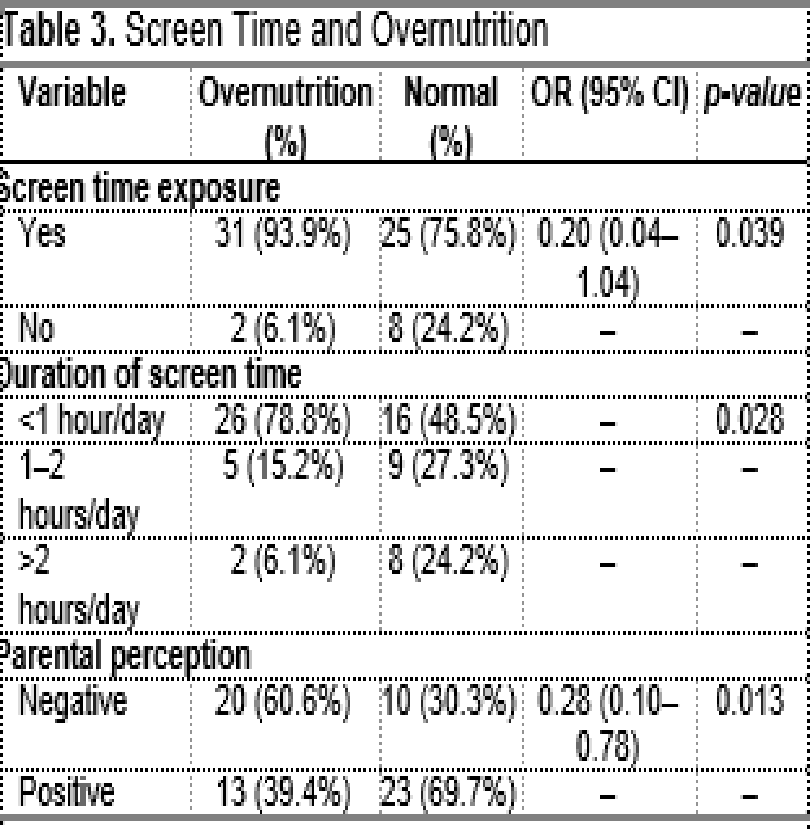
Results: Democratic feeding style showed a protective association with overnutrition (OR=0.12; p<0.001), whereas permissive feeding style increased the risk (OR=5.81; p=0.021). Authoritarian feeding style showed increased odds but was not statistically significant (p=0.105). Screen time and its duration were significantly associated with overnutrition (p=0.039 and p=0.028, respectively). Negative parental perceptions of screen time were associated with lower odds of overnutrition (OR=0.28; p=0.013).
Conclusion: Parental feeding style and screen time are significantly associated with overnutrition among toddlers aged 12–36 months. Interventions should focus on promoting responsive feeding practices and appropriate screen time management to support optimal child growth.

This work is licensed under a Creative Commons Attribution-NonCommercial 4.0 International License.
Authors who publish with this journal agree to the following terms:Authors retain copyright and grant the journal right of first publication with the work simultaneously licensed under a Creative Commons Attribution-NonCommercial 4.0 International License that allows others to share the work with an acknowledgement of the work's authorship and initial publication in this journal.
Authors are able to enter into separate, additional contractual arrangements for the non-exclusive distribution of the journal's published version of the work (e.g., post it to an institutional repository or publish it in a book), with an acknowledgement of its initial publication in this journal.
Authors are permitted and encouraged to post their work online (e.g., in institutional repositories or on their website) prior to and during the submission process, as it can lead to productive exchanges, as well as earlier and greater citation of published work (See The Effect of Open Access).
This work is licensed under a Creative Commons Attribution-NonCommercial 4.0 International License.