Early initiation of breastfeeding and immediate skin-to-skin contact are associated with lower hyperbilirubinemia risk in newborns from multifetal pregnancies

Downloads
Background: Neonatal hyperbilirubinemia is a common condition and a major contributor to neonatal morbidity, particularly among infants from multifetal pregnancies who are at increased risk due to prematurity and low birth weight. Early initiation of breastfeeding, supported by immediate skin-to-skin contact, may improve neonatal adaptation; however, evidence in multifetal populations within primary healthcare settings remains limited.
Purpose: This study aimed to examine the association between early initiation of breastfeeding, supported by skin-to-skin contact, and the incidence of pathological hyperbilirubinemia among newborns from multifetal pregnancies.
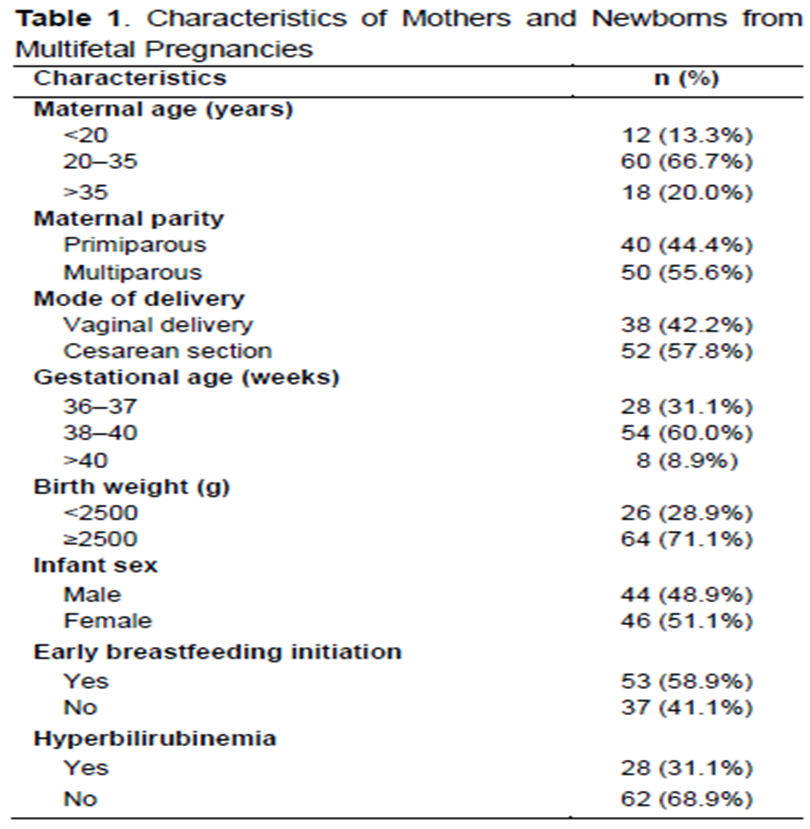
Methods: An analytic observational study with a cross-sectional design was conducted among 90 newborns from multifetal pregnancies at the Pasean Community Health Center, Pamekasan, between January and September 2025. Early breastfeeding initiation was assessed through direct observation, and total serum bilirubin levels were measured within the first 72 hours using spectrophotometry. Data were analyzed using the Chi-square test and multivariate logistic regression to estimate adjusted odds ratios (ORs) with 95% confidence intervals (CIs).
Results: Early breastfeeding initiation was implemented in 58.9% of newborns, and pathological hyperbilirubinemia occurred in 31.1%. A significant association was observed between early breastfeeding initiation and hyperbilirubinemia (p = 0.003). Newborns who did not receive early breastfeeding initiation had higher odds of developing hyperbilirubinemia compared with those who received it (adjusted OR 6.52; 95% CI: 1.98–21.47), after adjusting for birth weight, gestational age, and mode of delivery.
Conclusion: Early initiation of breastfeeding is associated with a reduced risk of pathological hyperbilirubinemia in newborns from multifetal pregnancies. Strengthening its implementation may provide a simple and effective strategy to improve neonatal outcomes, particularly in primary healthcare settings.

This work is licensed under a Creative Commons Attribution-NonCommercial 4.0 International License.
Authors who publish with this journal agree to the following terms:Authors retain copyright and grant the journal right of first publication with the work simultaneously licensed under a Creative Commons Attribution-NonCommercial 4.0 International License that allows others to share the work with an acknowledgement of the work's authorship and initial publication in this journal.
Authors are able to enter into separate, additional contractual arrangements for the non-exclusive distribution of the journal's published version of the work (e.g., post it to an institutional repository or publish it in a book), with an acknowledgement of its initial publication in this journal.
Authors are permitted and encouraged to post their work online (e.g., in institutional repositories or on their website) prior to and during the submission process, as it can lead to productive exchanges, as well as earlier and greater citation of published work (See The Effect of Open Access).
This work is licensed under a Creative Commons Attribution-NonCommercial 4.0 International License.