Effect of integrated non-pharmacological therapy on second-stage labor duration and neonatal Apgar scores

Downloads
Background: Childbirth is a physiological process influenced by maternal physical and psychological conditions. A prolonged second stage of labor is associated with increased risks of maternal fatigue, birth canal trauma, and impaired neonatal adaptation. However, evidence regarding structured integrated non-pharmacological interventions during labor remains limited.
Purpose: This study aimed to evaluate the effect of an integrated non-pharmacological intervention on second-stage labor duration and neonatal Apgar scores.
Methods: A quasi-experimental study was conducted from January to June 2025 among 60 women with term singleton pregnancies (intervention, n = 30; control, n = 30). Participants were allocated consecutively into two groups. The intervention consisted of Qur’anic recitation, cold compress application, and effleurage massage. The primary outcome was second-stage labor duration, and secondary outcomes were Apgar scores at 1 and 5 minutes after birth. Data were analyzed using independent t-tests and regression analysis, with a significance level of p < 0.05.
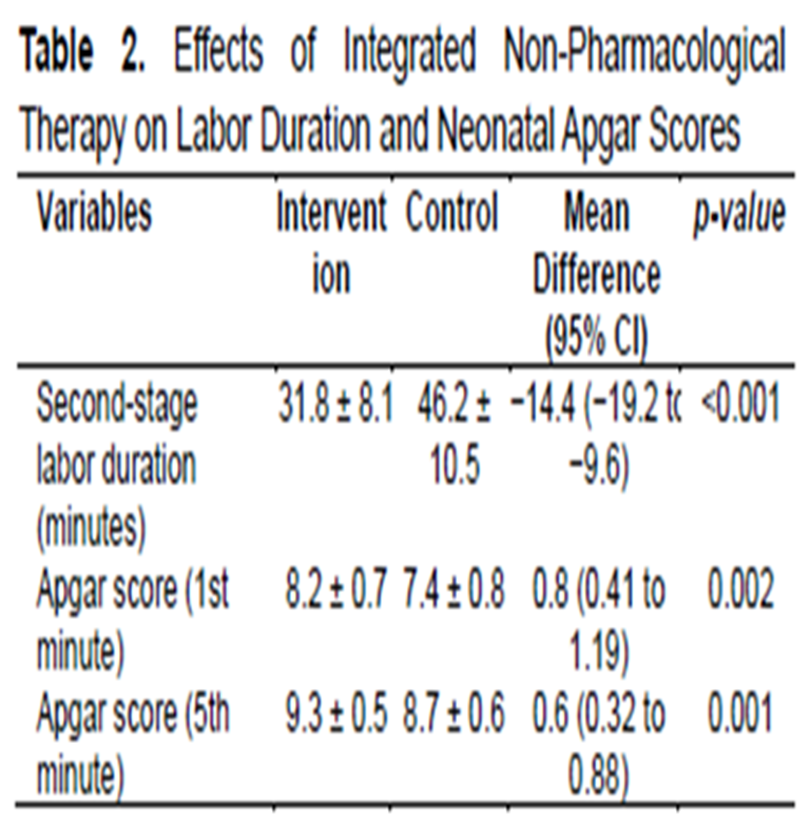
Results: The intervention group had a significantly shorter second-stage labor duration than the control group (mean difference = −14.4 minutes; 95% CI: −19.2 to −9.6; p < 0.001). Neonates in the intervention group had significantly higher Apgar scores at 1 minute (mean difference = 0.8; 95% CI: 0.41 to 1.19; p = 0.002) and 5 minutes (mean difference = 0.6; 95% CI: 0.32 to 0.88; p = 0.001).
Conclusions: An integrated non-pharmacological intervention was associated with shorter second-stage labor duration and higher early neonatal Apgar scores. This multimodal approach may provide a feasible, low-cost supportive strategy for intrapartum care in low-resource settings. Further randomized controlled trials are warranted to confirm these findings.

This work is licensed under a Creative Commons Attribution-NonCommercial 4.0 International License.
Authors who publish with this journal agree to the following terms:Authors retain copyright and grant the journal right of first publication with the work simultaneously licensed under a Creative Commons Attribution-NonCommercial 4.0 International License that allows others to share the work with an acknowledgement of the work's authorship and initial publication in this journal.
Authors are able to enter into separate, additional contractual arrangements for the non-exclusive distribution of the journal's published version of the work (e.g., post it to an institutional repository or publish it in a book), with an acknowledgement of its initial publication in this journal.
Authors are permitted and encouraged to post their work online (e.g., in institutional repositories or on their website) prior to and during the submission process, as it can lead to productive exchanges, as well as earlier and greater citation of published work (See The Effect of Open Access).
This work is licensed under a Creative Commons Attribution-NonCommercial 4.0 International License.