Development and evaluation of a TinyML-based sensor fusion system for medical waste classification on low-cost embedded devices

Downloads
Background: Medical waste management in resource-limited healthcare facilities remains dominated by manual segregation, which is error-prone and difficult to standardize. Existing automated solutions often rely on cloud-based deep learning or high-cost hardware, limiting real-time deployment at the point of waste generation.
Objective: This study aimed to develop and evaluate a medical waste classification system integrating Tiny Machine Learning (TinyML) and multi-sensor fusion on a low-cost embedded device to achieve accurate, real-time, and resource-efficient on-device inference.
Method: An experimental system design approach was employed, including dataset construction, model development, and embedded deployment. A TinyML-optimized MobileNetV2 model was integrated with heterogeneous sensor fusion and evaluated under embedded constraints to assess classification performance, latency, and memory usage.
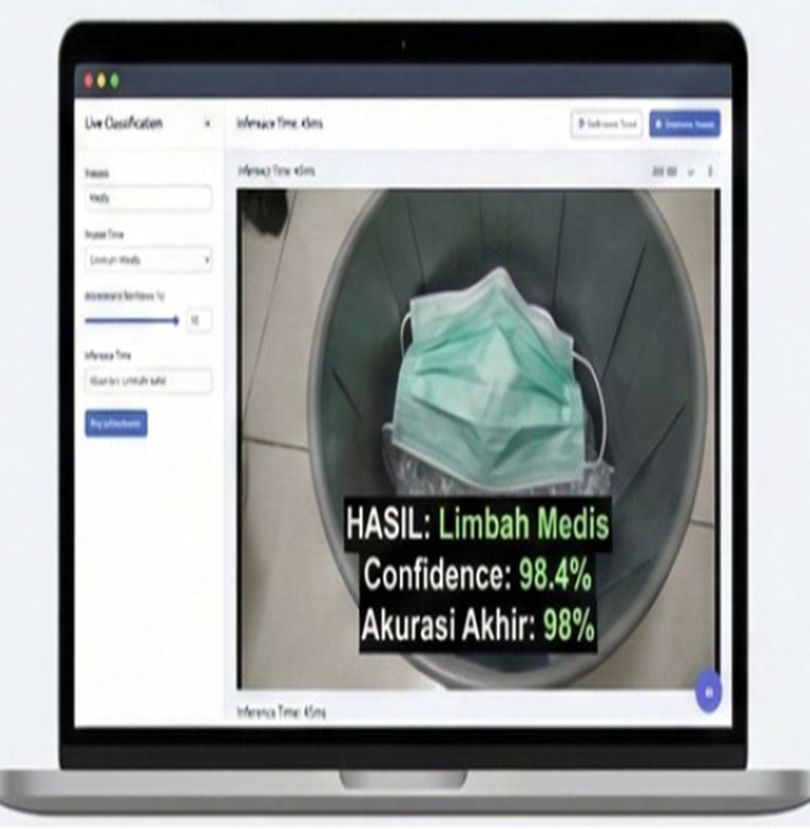
Result: The vision-only model achieved an accuracy of 84.5%, with frequent misclassification of sharps waste. After integrating sensor fusion, overall accuracy increased to 96.5%, and recall for sharps reached 98%. The system demonstrated efficient on-device inference with an average latency of 280 ms and low memory consumption (<1 MB).
Conclusion: The proposed TinyML-based sensor fusion system provides a robust, accurate, and cost-effective solution for automated medical waste classification. This approach enhances healthcare worker safety and supports scalable deployment in resource-limited healthcare environments.

This work is licensed under a Creative Commons Attribution-NonCommercial 4.0 International License.
Authors who publish with this journal agree to the following terms:Authors retain copyright and grant the journal right of first publication with the work simultaneously licensed under a Creative Commons Attribution-NonCommercial 4.0 International License that allows others to share the work with an acknowledgement of the work's authorship and initial publication in this journal.
Authors are able to enter into separate, additional contractual arrangements for the non-exclusive distribution of the journal's published version of the work (e.g., post it to an institutional repository or publish it in a book), with an acknowledgement of its initial publication in this journal.
Authors are permitted and encouraged to post their work online (e.g., in institutional repositories or on their website) prior to and during the submission process, as it can lead to productive exchanges, as well as earlier and greater citation of published work (See The Effect of Open Access).
This work is licensed under a Creative Commons Attribution-NonCommercial 4.0 International License.