Transport index in lymphoscintigraphy for patients with lymphedema: a case report

Downloads
Background: Lymphedema is an interstitial edema caused by impaired lymphatic drainage. Lymphoscintigraphy is a functional imaging modality used to evaluate lymphatic flow and diagnose lymphedema, with interpretation performed qualitatively and semi-quantitatively using the Transport Index (TI).
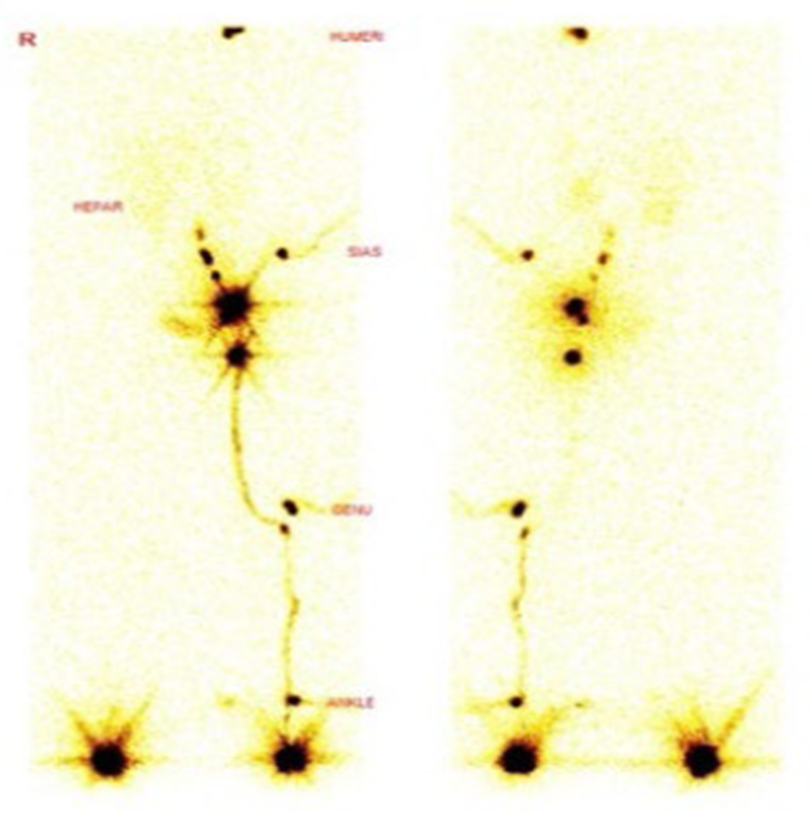
Case Presentation: Four patients with progressive unilateral extremity swelling at RSUP M. Djamil Hospital underwent lymphoscintigraphy. Subcutaneous injections of 99mTc-albumin nanocolloid were administered into both extremities, followed by dynamic and delayed imaging up to three hours after injection. Two patients showed complete lymphatic obstruction with TI scores of 36, while contralateral extremities demonstrated normal lymphatic transport (TI 1.2). The remaining two patients showed delayed lymphatic drainage with TI scores of 10.2, whereas contralateral extremities demonstrated near-normal TI values (1.2–4.2). TI values <10 indicate normal lymphatic transport, whereas values ≥10 reflect lymphatic dysfunction.
Conclusion: Qualitative and semi-quantitative analyses using the Transport Index provide consistent results in evaluating lymphatic dysfunction. Lymphoscintigraphy combined with TI scoring offers an objective and reproducible approach to improve diagnostic accuracy and support clinical decision-making, including treatment planning and disease monitoring.

This work is licensed under a Creative Commons Attribution-NonCommercial 4.0 International License.
Authors who publish with this journal agree to the following terms:Authors retain copyright and grant the journal right of first publication with the work simultaneously licensed under a Creative Commons Attribution-NonCommercial 4.0 International License that allows others to share the work with an acknowledgement of the work's authorship and initial publication in this journal.
Authors are able to enter into separate, additional contractual arrangements for the non-exclusive distribution of the journal's published version of the work (e.g., post it to an institutional repository or publish it in a book), with an acknowledgement of its initial publication in this journal.
Authors are permitted and encouraged to post their work online (e.g., in institutional repositories or on their website) prior to and during the submission process, as it can lead to productive exchanges, as well as earlier and greater citation of published work (See The Effect of Open Access).
This work is licensed under a Creative Commons Attribution-NonCommercial 4.0 International License.