Anti-inflammatory and hepatoprotective effects of Moringa oleifera fruit in obesity-induced liver injury

Downloads
Background: Hepatic metabolic disorders are closely associated with obesity and are characterized by systemic inflammation and liver injury. Moringa oleifera fruit contains various bioactive compounds with potential anti-inflammatory and hepatoprotective properties. However, evidence regarding its effects on obesity-induced liver injury remains limited..
Objective: This study aimed to evaluate the anti-inflammatory and hepatoprotective effects of Moringa oleifera fruit extract in an obesity-induced rat model..
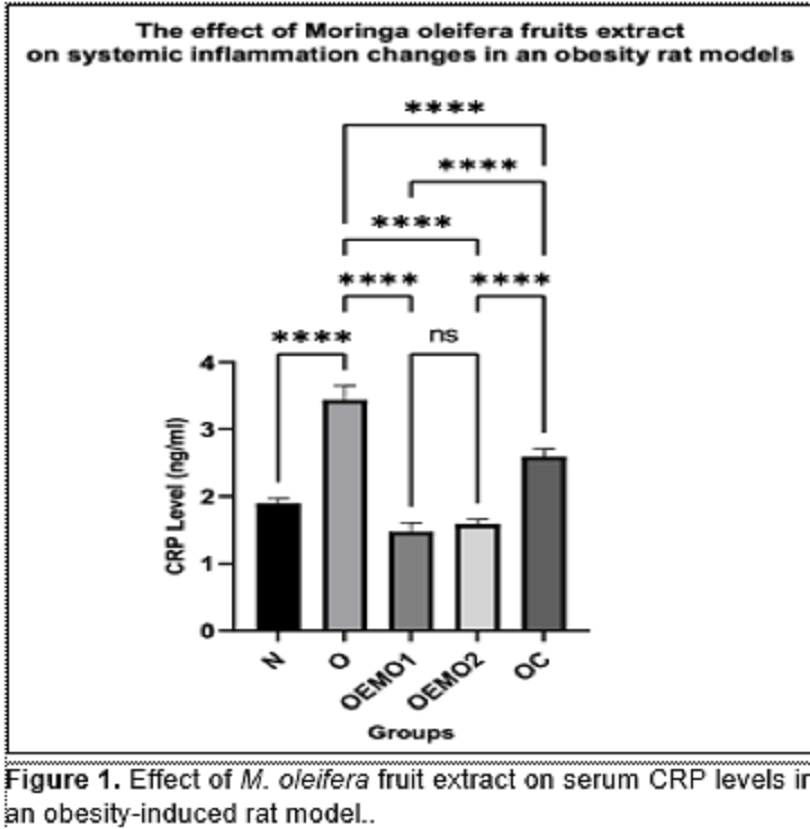
Methods: This experimental study used 30 male Sprague-Dawley rats divided into five groups: normal control (N), obese control (O), obese rats treated with Moringa oleifera fruit extract at 500 mg/kg body weight once daily (OEMO1), twice daily (OEMO2), and obese rats treated with vitamin C (OC). Systemic inflammation was assessed by measuring serum C-reactive protein (CRP) levels using ELISA, while hepatic changes were evaluated through biochemical markers and histopathological analysis. Data were analyzed using one-way ANOVA followed by post hoc testing.
Results: Obese rats exhibited significantly elevated serum CRP levels and marked hepatic alterations compared to normal controls (p < 0.05). Administration of Moringa oleifera fruit extract significantly reduced CRP levels and improved hepatic histoarchitecture in obese rats, with the greatest effect observed in the twice-daily treatment group (OEMO2) (p < 0.05). The effects were comparable to or greater than those observed with vitamin C.
Conclusions: Moringa oleifera fruit extract demonstrates significant anti-inflammatory and hepatoprotective effects in an obesity-induced rat model, suggesting its potential as a natural therapeutic agent for obesity-related liver injury.

This work is licensed under a Creative Commons Attribution-NonCommercial 4.0 International License.
Authors who publish with this journal agree to the following terms:Authors retain copyright and grant the journal right of first publication with the work simultaneously licensed under a Creative Commons Attribution-NonCommercial 4.0 International License that allows others to share the work with an acknowledgement of the work's authorship and initial publication in this journal.
Authors are able to enter into separate, additional contractual arrangements for the non-exclusive distribution of the journal's published version of the work (e.g., post it to an institutional repository or publish it in a book), with an acknowledgement of its initial publication in this journal.
Authors are permitted and encouraged to post their work online (e.g., in institutional repositories or on their website) prior to and during the submission process, as it can lead to productive exchanges, as well as earlier and greater citation of published work (See The Effect of Open Access).
This work is licensed under a Creative Commons Attribution-NonCommercial 4.0 International License.