Effectiveness of wamena pugima honey on incision wound healing: an experimental study

Downloads
Background: Honey contains bioactive compounds that may accelerate wound healing; however, its therapeutic effectiveness varies depending on botanical origin. Wamena Pugima honey, a local Papuan honey, is presumed to possess unique bioactive properties due to endemic flora, yet its efficacy in wound healing has not been scientifically evaluated.
Objective: This study aimed to evaluate the effectiveness of Pugima honey on incision wound healing using a Swiss Webster mouse model.
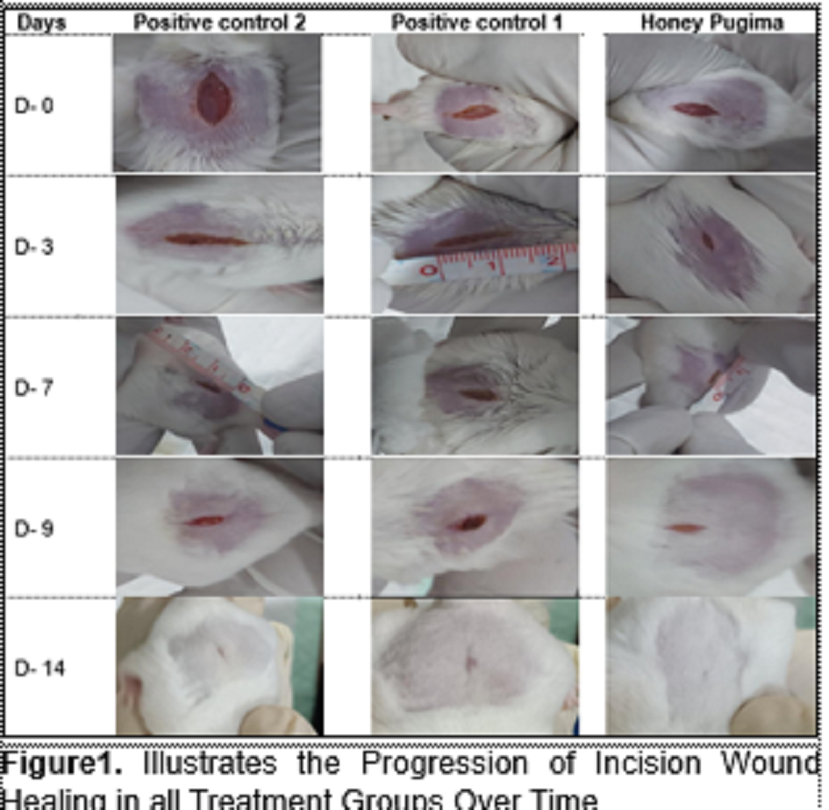
Methods: his experimental study employed a randomized controlled design involving 36 male Swiss Webster mice, randomly allocated into three groups (n = 12 per group): positive control 1 (C1, 3% oxytetracycline ointment), combination control (C2, oxytetracycline ointment plus Pugima honey), and treatment group (P1, Pugima honey). Phytochemical screening was conducted to identify bioactive compounds. Wound length was measured on Days 3, 7, 9, 13, and 14, and wound contraction percentage was calculated accordingly. Statistical analysis was performed using the Kruskal–Wallis test followed by Dunn’s post hoc test.
Results: Phytochemical screening revealed the presence of flavonoids, phenols, tannins, and saponins, indicating potential anti-inflammatory and antibacterial properties. The Pugima honey group (P1) demonstrated significantly accelerated wound healing compared to both control groups, with shorter wound length observed as early as Day 3 (10.50 ± 1.83 mm vs. 14.00 ± 1.12 mm in C1; p = 0.001).
Conclusions: Pugima honey significantly enhances incision wound healing, particularly during the early to intermediate phases, and shows potential as a natural therapeutic agent for wound management.

This work is licensed under a Creative Commons Attribution-NonCommercial 4.0 International License.
Authors who publish with this journal agree to the following terms:Authors retain copyright and grant the journal right of first publication with the work simultaneously licensed under a Creative Commons Attribution-NonCommercial 4.0 International License that allows others to share the work with an acknowledgement of the work's authorship and initial publication in this journal.
Authors are able to enter into separate, additional contractual arrangements for the non-exclusive distribution of the journal's published version of the work (e.g., post it to an institutional repository or publish it in a book), with an acknowledgement of its initial publication in this journal.
Authors are permitted and encouraged to post their work online (e.g., in institutional repositories or on their website) prior to and during the submission process, as it can lead to productive exchanges, as well as earlier and greater citation of published work (See The Effect of Open Access).
This work is licensed under a Creative Commons Attribution-NonCommercial 4.0 International License.