Development and evaluation of an Android-based application to enhance disaster preparedness among maternal populations

Downloads
Background: Natural disasters pose significant risks to vulnerable populations, particularly pregnant, postpartum, and breastfeeding women, who face increased health and safety challenges during emergencies. Strengthening disaster preparedness through accessible educational strategies is essential to improve resilience and reduce adverse outcomes.
Objective: This study aimed to develop and evaluate an Android-based application as an educational tool to enhance disaster preparedness among maternal populations.
Methods: This study employed a Research and Development (R&D) approach based on the Borg and Gall model, followed by feasibility and effectiveness evaluation. Data were collected through interviews, validation assessments, and structured questionnaires. The application was tested among pregnant, postpartum, and breastfeeding women using a pretest–posttest design to assess changes in disaster preparedness knowledge.
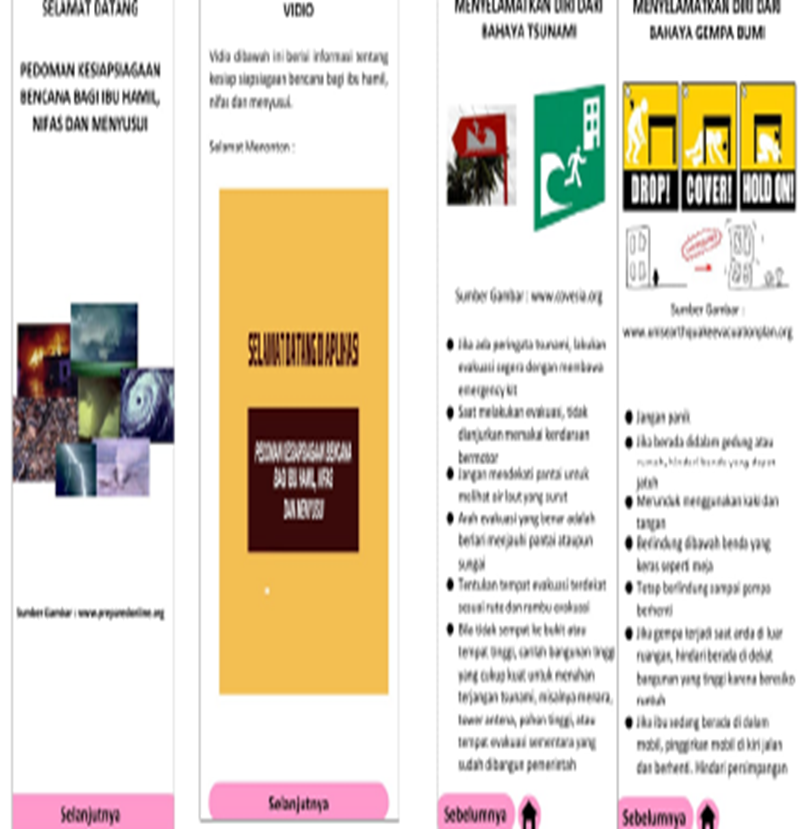
Results: The developed application, named “Ibu Siaga Bencana,” demonstrated high content and media validity. Preliminary testing showed good usability and practicality. Effectiveness evaluation indicated a 40% increase in participants' disaster preparedness knowledge following application use, suggesting a substantial improvement in understanding.
Conclusion: The application is a feasible and effective educational tool for improving disaster preparedness among maternal populations. Further studies with larger samples and more rigorous designs are needed to confirm its effectiveness and long-term impact.

This work is licensed under a Creative Commons Attribution-NonCommercial 4.0 International License.
Authors who publish with this journal agree to the following terms:Authors retain copyright and grant the journal right of first publication with the work simultaneously licensed under a Creative Commons Attribution-NonCommercial 4.0 International License that allows others to share the work with an acknowledgement of the work's authorship and initial publication in this journal.
Authors are able to enter into separate, additional contractual arrangements for the non-exclusive distribution of the journal's published version of the work (e.g., post it to an institutional repository or publish it in a book), with an acknowledgement of its initial publication in this journal.
Authors are permitted and encouraged to post their work online (e.g., in institutional repositories or on their website) prior to and during the submission process, as it can lead to productive exchanges, as well as earlier and greater citation of published work (See The Effect of Open Access).
This work is licensed under a Creative Commons Attribution-NonCommercial 4.0 International License.