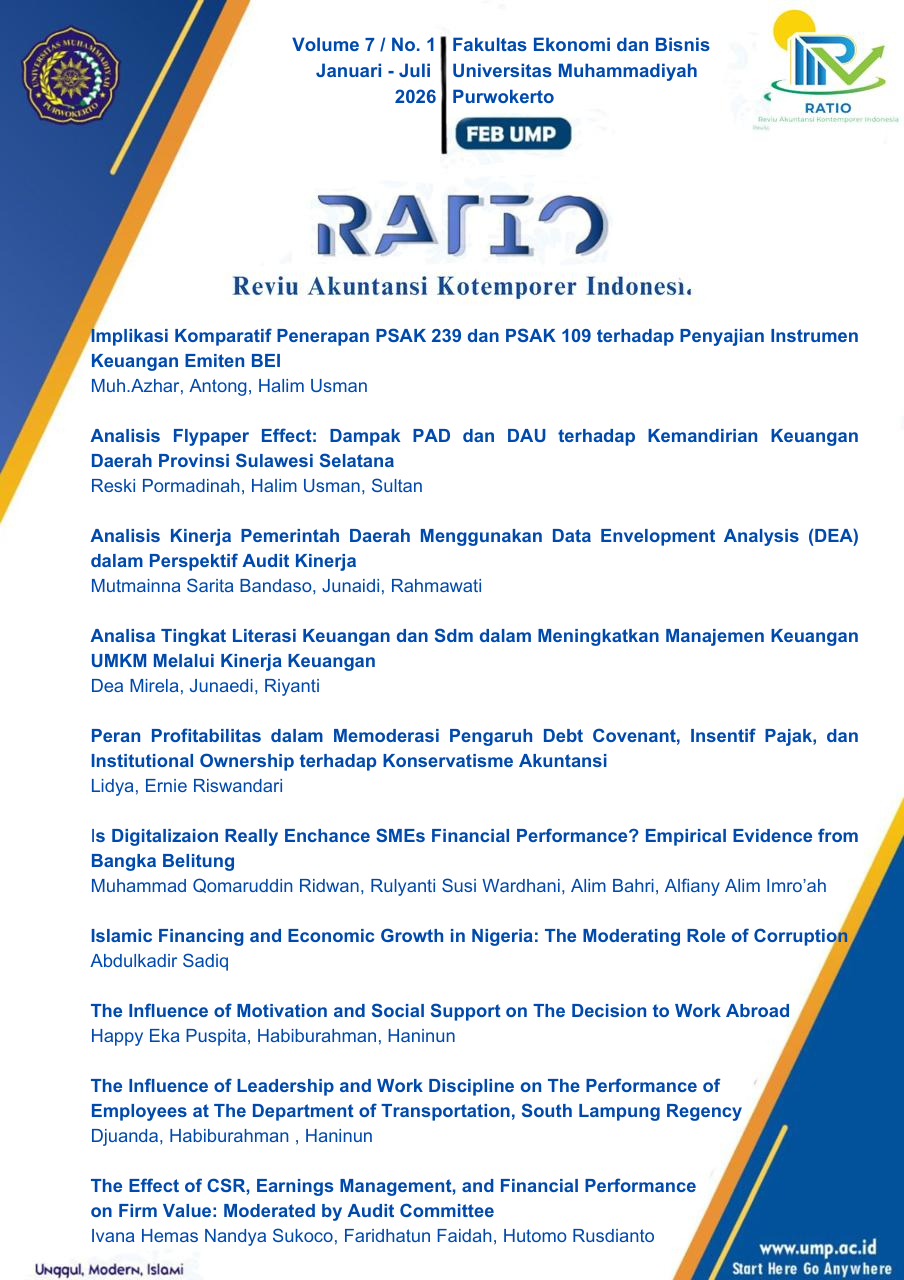
Peran Profitabilitas Dalam Memoderasi Pengaruh Debt Covenant, Insentif Pajak, Dan Institutional Ownership Terhadap Konservatisme Akuntansi
DOI:
https://doi.org/10.30595/ratio.v7i1.28779Keywords:
Accounting Conservatism; Debt covenant; Tax Incentive; Institutional Ownership; ProfitabilityAbstract
Accounting conservatism is an important principle to present financial statements with caution, especially in uncertain economic conditions. However, its application still raises various pro and con arguments. The purpose of this study is to determine the effect of debt covenants, tax incentives, and institutional ownership on accounting conservatism which will be moderated by profitability. This study uses secondary data form financial reports of consumer non-cylicals sector companies listed on the Indonesia Stock Exchange in 2020-2023. The sample was selected using purposive sampling method with moderated regression analysis. The results found that debt covenants and tax incentives have a negative effect on accounting conservatism, institutional ownership has no effect on accounting conservatism, profitability has a positive effect on accounting conservatism, and profitability succeeded in strengthening the negative effect of debt covenants on accounting conservatism, but profitability didn’t succeed in moderating the effect of tax incentives and institutional ownership on accounting conservatism.
References
Aburisheh, K. E., Dahiyat, A. A., Owais, W. O., Al Shanti, A. M., & AlQudah, L. A. (2022). The effect of ownership structure and board structure on accounting conservatism throughout financial reporting: Evidence from Jordanian industrial corporations. Cogent Business and Management, 9(1). https://doi.org/10.1080/23311975.2022.2112819
Agustina, L., Apriliyani, P., & Jati, K. waluyo. (2023). The Influence of Managerial Ownership, Institutional Ownership, Investment Opportunity Set, and Capital Intensity on Accounting Conservatism with Political Connections as A Moderation Variable. Accounting Analysis Journal, 11(1), 64–74. https://doi.org/10.15294/aaj.v11i1.63340
Ahalik, Suratman, A., & Hidayati, N. (2021). The effect of debt covenant, political cost and ifrs implementation towards the company value. Accounting, 7(4), 907–916. https://doi.org/10.5267/j.ac.2021.1.017
Aini, N., Pirmaningsih, L., & Pradika, N. A. (2023). The Role of Good Corporate Governance in Influenced Accounting Conservatism of Manufacturing Companies in Indonesia. IJEBD (International Journal of Entrepreneurship and Business Development), 6(6), 1094–1105. https://doi.org/10.29138/ijebd.v6i6.2572
Ardiansyah, M. (2022). Accounting Conservatism in the Perspective of Positive Accounting Theory: a Study of Islamic Banking in Indonesia. Asian Economic and Financial Review, 12(6), 380–396. https://doi.org/10.55493/5002.v12i6.4500
Bayu Aji, S., Djasmanuddin, D., & Andriono, A. (2021). Pengaruh Capital Structure, Institutional Ownership, Dan Managerial Ownership Terhadap Profitabilitas Perusahaan. Kajian Ekonomi Dan Bisnis, 16(2), 199–214. https://doi.org/10.51277/keb.v16i2.103
Efendi, M. J., Huda, K., Sholeh, R., & Waluyo, S. E. Y. (2023). Determination Of Debt Covenant, Leverage , Financial Distress Against Accounting Conservatism. IJEBD (International Journal of Entrepreneurship and Business Development), 6(6), 1144–1156. https://doi.org/10.29138/ijebd.v6i6.2584
Eisenhardt, K. M. (1989). Agency Theory : An Assessment and Review. The Academy of Management Review, 14(1)(1), 57–74.
Fauzi, E. N., & Badriyah, M. (2023). Praktik Konservatisme Akuntansi Perusahaan Sektor Pertambangan: Peran Debt Covenant Dan Profitabilitas. Finansha: Journal of Sharia Financial Management, 4(1), 1–17. https://doi.org/10.15575/fjsfm.v4i1.20885
Hajawiyah, A., Wahyudin, A., Kiswanto, Sakinah, & Pahala, I. (2020). The effect of good corporate governance mechanisms on accounting conservatism with leverage as a moderating variable. Cogent Business and Management, 7(1). https://doi.org/10.1080/23311975.2020.1779479
Hardiyanti, F., Azmi, Z., & Ahyaruddin, M. (2022). The Effect Of Debt Covenant, Leverage, Growth Opportunities And Financial Distress On Accounting Conservatism. Bilancia: Jurnal Ilmiah Akuntansi, 6(1), 31–48.
Harini, G., Syamra, Y., & Setiawan, P. (2020). Pengaruh Insentif Pajak , Pajak , dan Cash Flow terhadap Konservatisme. Jurnal Manajemen Dan Kewirausahaan, 1(Januari), 10–23.
Hermanto, & Rizki, N. (2022). Pengaruh Biaya Agensi, Intesitas Modal, Kebijakan Huntang Terhadap Konservatisme Akuntansi, Profitabilitas Sebagai Variabel Moderating. Syntax Literate: Jurnal Ilmiah Indonesia, 7(10), 2548–1398.
Indahsari, D. N., & Fitriandi, P. (2021). Pengaruh Kebijakan Insentif Pajak Di Masa Pandemi Covid-19 Terhadap Penerimaan Ppn. Jurnal Pajak Dan Keuangan Negara (PKN), 3(1), 24–36. https://doi.org/10.31092/jpkn.v3i1.1202
Jaya, A. A., & Maria, M. (2022). Pengaruh Financial Distress, Growth Opportunity, Kepemilikan Institusional, Kepemilikan Manajerial, Debt Covenant, Dan Intensitas Modal Terhadap Konservatisme Akuntansi. E-Jurnal Akuntansi TSM, 2(3), 109–120. https://doi.org/10.34208/ejatsm.v2i3.1606
Jensen, M. C., & Meckling, W. H. (1976). THEORY OF THE FIRM : MANAGERIAL BEHAVIOR , AGENCY COSTS AND OWNERSHIP STRUCTURE. Journal of Financial Economics, 3, 305–360.
Liasari, E. F., & Biduri, S. (2023). Effect of Financial Distress, Leverage, and Company Size on Accounting Conservatism with Profitability as a Moderating Variable. Jurnal Universitas Muhammadiyah Sidoarjo, 1–10. http://dx.doi.org/10.21070/ups.3000
Michael Spence. (1973). Job Market Signaling. The Quarterly Journal of Economics, 87(3), 355–374.
Ningsih, D. F., & Utama, D. P. (2021). Analysis of Debt Effect on Profitability of Manufacturing Companies in Indonesia. Journal of Applied Accounting and Taxation, 6(1), 97–107. https://doi.org/10.30871/jaat.v6i1.2750
Novari, R., Yusnaini, Y., & Fuadah, L. L. (2021). The Impact of Tax Incentives, Political Costs, Litigation Risk and Equity Valuation on Accounting Conservatism. Oblik i Finansi, 4(4(94)), 39–45. https://doi.org/10.33146/2307-9878-2021-4(94)-39-45
Pangkey, R., Kantohe, M., & Karwur, Y. (2024). Pengaruh Insentif Pajak dan Kualitas Audit Terhadap Konservatisme Akuntansi. Jurnal Akuntansi Manado (JAIM), 5(1), 300–310. https://doi.org/10.53682/jaim.vi.4458
Picas, S., Reis, P., Pinto, A., & Abrantes, J. L. (2021). Does tax, financial, and government incentives impact long-term portuguese smes’ sustainable company performance? Sustainability (Switzerland), 13(21). https://doi.org/10.3390/su132111866
Prayudiawan, H., & Pamungkas, J. D. (2020). Pengaruh Debt Covenant, Profitability, Exchange Rate, Mekanisme Bonus Pada Transfer Pricing. Akuntabilitas, 13(1), 97–108. https://doi.org/10.15408/akt.v13i1.15328
Priyono, M. Y. V., & Suhartini, D. (2022). Pengaruh Firm Size, Cash Flow, Leverage, Growth Opportunity, Dan Profitability Terhadap Konservatisme Akuntansi. Jambura : Economic Education Journal, 4(1), 51–65. https://doi.org/10.37479/jeej.v4i1.11117
Purwasih, D. (2020). Pengaruh Mekanisme Corporate Governance, Ukuran Perusahaan dan Debt to Equity Ratio terhadap Konservatisme Akuntansi. JABI (Jurnal Akuntansi Berkelanjutan Indonesia), 3(3), 309–326. https://doi.org/10.32493/jabi.v3i3.y2020.p309-326
Puspita, D. A., Permata Sari, Y. I., & Sugiono, D. (2023). Debt Covenant, Financial Distress Dan Pengaruhnya Terhadap Konservatisme Akuntansi. Inspirasi Ekonomi : Jurnal Ekonomi Manajemen, 5(4), 281–288. https://doi.org/10.32938/ie.v5i4.5602
Putra, G. H., & Satria, D. N. (2022). Pengaruh Komisaris Independen Dan Kepemilikan Institusional Terhadap Konservatisme Akuntansi Pada Perusahaan BUMN. Owner, 6(4), 3433–3444. https://doi.org/10.33395/owner.v6i4.1156
Putra, I. W. D., & Sari, V. F. (2020). Pengaruh Financial Distress, Leverage, Dan Profitabilitas Terhadap Konservatisme Akuntansi. Jurnal Eksplorasi Akuntansi, 2(4), 3500–3516. https://doi.org/10.24036/jea.v2i4.299
Putri, A. A., & Nurcholisah, K. (2023). Pengaruh Profitabilitas dan Struktur Kepemilikan Manajerial terhadap Konservatisme Akuntansi. Bandung Conference Series: Accountancy, 3(1). https://doi.org/10.29313/bcsa.v3i1.5771
Rahayu, M. B. (2020). Pengaruh Profitabilitas Terhadap Struktur Keuangan. Jurnal Studi Manajemen Dan Bisnis, 5(2), 75–79. https://doi.org/10.21107/jsmb.v5i2.6656
Riani, D., N.A. Rumiasih, N. A. R., Ratnawati, D., & Maulani, D. (2023). Pengaruh Debt Covenant, Company Growth, Invesment Opportunity Set dan Dividend Aburisheh, K. E., Dahiyat, A. A., Owais, W. O., Al Shanti, A. M., & AlQudah, L. A. (2022). The effect of ownership structure and board structure on accounting conservatism throughout financial reporting: Evidence from Jordanian industrial corporations. Cogent Business and Management, 9(1). https://doi.org/10.1080/23311975.2022.2112819
Agustina, L., Apriliyani, P., & Jati, K. waluyo. (2023). The Influence of Managerial Ownership, Institutional Ownership, Investment Opportunity Set, and Capital Intensity on Accounting Conservatism with Political Connections as A Moderation Variable. Accounting Analysis Journal, 11(1), 64–74. https://doi.org/10.15294/aaj.v11i1.63340
Ahalik, Suratman, A., & Hidayati, N. (2021). The effect of debt covenant, political cost and ifrs implementation towards the company value. Accounting, 7(4), 907–916. https://doi.org/10.5267/j.ac.2021.1.017
Aini, N., Pirmaningsih, L., & Pradika, N. A. (2023). The Role of Good Corporate Governance in Influenced Accounting Conservatism of Manufacturing Companies in Indonesia. IJEBD (International Journal of Entrepreneurship and Business Development), 6(6), 1094–1105. https://doi.org/10.29138/ijebd.v6i6.2572
Ardiansyah, M. (2022). Accounting Conservatism in the Perspective of Positive Accounting Theory: a Study of Islamic Banking in Indonesia. Asian Economic and Financial Review, 12(6), 380–396. https://doi.org/10.55493/5002.v12i6.4500
Bayu Aji, S., Djasmanuddin, D., & Andriono, A. (2021). Pengaruh Capital Structure, Institutional Ownership, Dan Managerial Ownership Terhadap Profitabilitas Perusahaan. Kajian Ekonomi Dan Bisnis, 16(2), 199–214. https://doi.org/10.51277/keb.v16i2.103
Efendi, M. J., Huda, K., Sholeh, R., & Waluyo, S. E. Y. (2023). Determination Of Debt Covenant, Leverage , Financial Distress Against Accounting Conservatism. IJEBD (International Journal of Entrepreneurship and Business Development), 6(6), 1144–1156. https://doi.org/10.29138/ijebd.v6i6.2584
Eisenhardt, K. M. (1989). Agency Theory : An Assessment and Review. The Academy of Management Review, 14(1)(1), 57–74.
Fauzi, E. N., & Badriyah, M. (2023). Praktik Konservatisme Akuntansi Perusahaan Sektor Pertambangan: Peran Debt Covenant Dan Profitabilitas. Finansha: Journal of Sharia Financial Management, 4(1), 1–17. https://doi.org/10.15575/fjsfm.v4i1.20885
Hajawiyah, A., Wahyudin, A., Kiswanto, Sakinah, & Pahala, I. (2020). The effect of good corporate governance mechanisms on accounting conservatism with leverage as a moderating variable. Cogent Business and Management, 7(1). https://doi.org/10.1080/23311975.2020.1779479
Hardiyanti, F., Azmi, Z., & Ahyaruddin, M. (2022). The Effect Of Debt Covenant, Leverage, Growth Opportunities And Financial Distress On Accounting Conservatism. Bilancia: Jurnal Ilmiah Akuntansi, 6(1), 31–48.
Harini, G., Syamra, Y., & Setiawan, P. (2020). Pengaruh Insentif Pajak , Pajak , dan Cash Flow terhadap Konservatisme. Jurnal Manajemen Dan Kewirausahaan, 1(Januari), 10–23.
Hermanto, & Rizki, N. (2022). Pengaruh Biaya Agensi, Intesitas Modal, Kebijakan Huntang Terhadap Konservatisme Akuntansi, Profitabilitas Sebagai Variabel Moderating. Syntax Literate: Jurnal Ilmiah Indonesia, 7(10), 2548–1398.
Indahsari, D. N., & Fitriandi, P. (2021). Pengaruh Kebijakan Insentif Pajak Di Masa Pandemi Covid-19 Terhadap Penerimaan Ppn. Jurnal Pajak Dan Keuangan Negara (PKN), 3(1), 24–36. https://doi.org/10.31092/jpkn.v3i1.1202
Jaya, A. A., & Maria, M. (2022). Pengaruh Financial Distress, Growth Opportunity, Kepemilikan Institusional, Kepemilikan Manajerial, Debt Covenant, Dan Intensitas Modal Terhadap Konservatisme Akuntansi. E-Jurnal Akuntansi TSM, 2(3), 109–120. https://doi.org/10.34208/ejatsm.v2i3.1606
Jensen, M. C., & Meckling, W. H. (1976). THEORY OF THE FIRM : MANAGERIAL BEHAVIOR , AGENCY COSTS AND OWNERSHIP STRUCTURE. Journal of Financial Economics, 3, 305–360.
Liasari, E. F., & Biduri, S. (2023). Effect of Financial Distress, Leverage, and Company Size on Accounting Conservatism with Profitability as a Moderating Variable. Jurnal Universitas Muhammadiyah Sidoarjo, 1–10. http://dx.doi.org/10.21070/ups.3000
Michael Spence. (1973). Job Market Signaling. The Quarterly Journal of Economics, 87(3), 355–374.
Ningsih, D. F., & Utama, D. P. (2021). Analysis of Debt Effect on Profitability of Manufacturing Companies in Indonesia. Journal of Applied Accounting and Taxation, 6(1), 97–107. https://doi.org/10.30871/jaat.v6i1.2750
Novari, R., Yusnaini, Y., & Fuadah, L. L. (2021). The Impact of Tax Incentives, Political Costs, Litigation Risk and Equity Valuation on Accounting Conservatism. Oblik i Finansi, 4(4(94)), 39–45. https://doi.org/10.33146/2307-9878-2021-4(94)-39-45
Pangkey, R., Kantohe, M., & Karwur, Y. (2024). Pengaruh Insentif Pajak dan Kualitas Audit Terhadap Konservatisme Akuntansi. Jurnal Akuntansi Manado (JAIM), 5(1), 300–310. https://doi.org/10.53682/jaim.vi.4458
Picas, S., Reis, P., Pinto, A., & Abrantes, J. L. (2021). Does tax, financial, and government incentives impact long-term portuguese smes’ sustainable company performance? Sustainability (Switzerland), 13(21). https://doi.org/10.3390/su132111866
Prayudiawan, H., & Pamungkas, J. D. (2020). Pengaruh Debt Covenant, Profitability, Exchange Rate, Mekanisme Bonus Pada Transfer Pricing. Akuntabilitas, 13(1), 97–108. https://doi.org/10.15408/akt.v13i1.15328
Priyono, M. Y. V., & Suhartini, D. (2022). Pengaruh Firm Size, Cash Flow, Leverage, Growth Opportunity, Dan Profitability Terhadap Konservatisme Akuntansi. Jambura : Economic Education Journal, 4(1), 51–65. https://doi.org/10.37479/jeej.v4i1.11117
Purwasih, D. (2020). Pengaruh Mekanisme Corporate Governance, Ukuran Perusahaan dan Debt to Equity Ratio terhadap Konservatisme Akuntansi. JABI (Jurnal Akuntansi Berkelanjutan Indonesia), 3(3), 309–326. https://doi.org/10.32493/jabi.v3i3.y2020.p309-326
Puspita, D. A., Permata Sari, Y. I., & Sugiono, D. (2023). Debt Covenant, Financial Distress Dan Pengaruhnya Terhadap Konservatisme Akuntansi. Inspirasi Ekonomi : Jurnal Ekonomi Manajemen, 5(4), 281–288. https://doi.org/10.32938/ie.v5i4.5602
Putra, G. H., & Satria, D. N. (2022). Pengaruh Komisaris Independen Dan Kepemilikan Institusional Terhadap Konservatisme Akuntansi Pada Perusahaan BUMN. Owner, 6(4), 3433–3444. https://doi.org/10.33395/owner.v6i4.1156
Putra, I. W. D., & Sari, V. F. (2020). Pengaruh Financial Distress, Leverage, Dan Profitabilitas Terhadap Konservatisme Akuntansi. Jurnal Eksplorasi Akuntansi, 2(4), 3500–3516. https://doi.org/10.24036/jea.v2i4.299
Putri, A. A., & Nurcholisah, K. (2023). Pengaruh Profitabilitas dan Struktur Kepemilikan Manajerial terhadap Konservatisme Akuntansi. Bandung Conference Series: Accountancy, 3(1). https://doi.org/10.29313/bcsa.v3i1.5771
Rahayu, M. B. (2020). Pengaruh Profitabilitas Terhadap Struktur Keuangan. Jurnal Studi Manajemen Dan Bisnis, 5(2), 75–79. https://doi.org/10.21107/jsmb.v5i2.6656
Riani, D., N.A. Rumiasih, N. A. R., Ratnawati, D., & Maulani, D. (2023). Pengaruh Debt Covenant, Company Growth, Invesment Opportunity Set dan Dividend Payout Ratio Terhadap Konservatisme Akuntansi. Kompartemen : Jurnal Ilmiah Akuntansi, 21(1), 80. https://doi.org/10.30595/kompartemen.v21i1.15511
Riset. (2022). Ngenes! Laba Bersih Anjlok, Saham ICBP dan INDF Babak Belur. CNBC Indonesia. https://www.cnbcindonesia.com/market/20220831093007-17-367968/ngenes-laba-bersih-anjlok-saham-icbp-dan-indf-babak-belur
Solikin, I., Wahyuni, A., & Darmawan, D. (2021). The Effect of Financial Difficulties and Institutional and Managerial Ownerships on Accounting Conservatism. Journal of Hunan University (Natural Sciences), 48(10), 255–264.
Stiawan, H., Ningsih, F. E., & Nurani, S. (2022). Pengaruh Insentif Pajak, Financial Distress, dan Capital Intensity Terhadap Konservatisme Akuntansi. Ekonomi, Keuangan, Investasi Dan Syariah (EKUITAS), 3(3), 510–520. https://doi.org/10.47065/ekuitas.v3i3.1086
Sugiyarti, L., & Rina, S. (2020). Pengaruh Insentif Pajak, Financial Distress, Earning Pressure Terhadap Konservatisme Akuntansi. Jurnal Litbang Sukowati : Media Penelitian Dan Pengembangan, 4(1), 10. https://doi.org/10.32630/sukowati.v4i1.148
Tamur, G. M. (2022). Pengaruh Kepemilikan Institusional, Debt Covenant Dan Growth Opportunity Terhadap Konservatisme Akuntansi. Akuntansi Dewantara, 6(1), 72–83. https://doi.org/10.26460/ad.v6i1.10368
Tazkiya, H., & Sulastiningsih. (2020). Pengaruh Growth Opportunity, Financial Distress, Ceo Retirement Terhadap Konservatisme Akuntansi. Kajian Bisnis STIE Widya Wiwaha, 28(1), 13–34. https://doi.org/10.32477/jkb.v28i1.375
Timorria, lim F. (2022). Ini Penyebab Laba Bersih Grup Indofood INDF dan ICBP Ambles di Kuartal III/2022. Bisnis.Com. https://market.bisnis.com/read/20221201/192/1604103/ini-penyebab-laba-bersih-grup-indofood-indf-dan-icbp-ambles-di-kuartal-iii2022
Watts, R. L., & Zimmerman, J. L. (1990). Positive Accounting Theory: A Ten Year Perspective. The Accounting Review, 65(1), 131–156. https://www.jstor.org/stable/247880
Yuniarsih, N., & Permatasari, A. (2021). Pengaruh Kepemilikan Institusional, Kepemilikan Manajerial, Leverage Terhadap Konservatisme Akuntansi Dengan Profitabilitas Sebagai Variabel Moderasi. JEA17: Jurnal Ekonomi Akuntansi, 6(1), 47–60. https://doi.org/10.30996/jea17.v6i1.5224
Zulni, Y., & Taqwa, S. (2023). Pengaruh Financial Distress, Kepemilikan Institusional, dan Growth Opportunities terhadap Konservatisme Akuntansi. Jurnal Eksplorasi Akuntansi, 5(1), 246–262. https://doi.org/10.24036/jea.v5i1.723
Downloads
Published
How to Cite
Issue
Section
License
Copyright (c) 2026 Lydya Lydya, Ernie Riswandari

This work is licensed under a Creative Commons Attribution 4.0 International License.
Authors who publish with this journal agree to the following terms:
Authors retain copyright and grant the journal right of first publication with the work simultaneously licensed under a Creative Commons Attribution License that allows others to share the work with an acknowledgement of the work's authorship and initial publication in this journal.
Authors are able to enter into separate, additional contractual arrangements for the non-exclusive distribution of the journal's published version of the work (e.g., post it to an institutional repository or publish it in a book), with an acknowledgement of its initial publication in this journal.
Authors are permitted and encouraged to post their work online (e.g., in institutional repositories or on their website) prior to and during the submission process, as it can lead to productive exchanges, as well as earlier and greater citation of published work (See The Effect of Open Access).

RATIO : Reviu Akuntansi Kontemporer Indonesia is licensed under a Creative Commons Attribution 4.0 International License.



_001.png)