One-year survival factors of patients with end-stage kidney disease in Bali, Indonesia

Downloads
Background: End-stage kidney disease (ESKD) is a global health challenge contributing to 2.2–7 million deaths annually due to inadequate treatment access. Identifying determinants of survival is critical for improving patient outcomes. To date, no study in Bali has evaluated the one-year survival of ESKD patients.
Purpose: This study aimed to identify factors associated with one-year survival among patients with ESKD in Bali, Indonesia.
Methods: A retrospective cohort study was conducted at Wangaya Regional General Hospital from November 2024 to March 2025, involving 210 patients aged ≥18 years diagnosed with ESKD between 2022 and 2024. Survival status was assessed over one year. Predictive factors, including age, gender, diabetes mellitus, control compliance, dialysis status, haemoglobin, blood urea nitrogen (BUN), serum creatinine (SC), and estimated glomerular filtration rate (eGFR), were analysed using Kaplan-Meier and Cox proportional hazards regression.
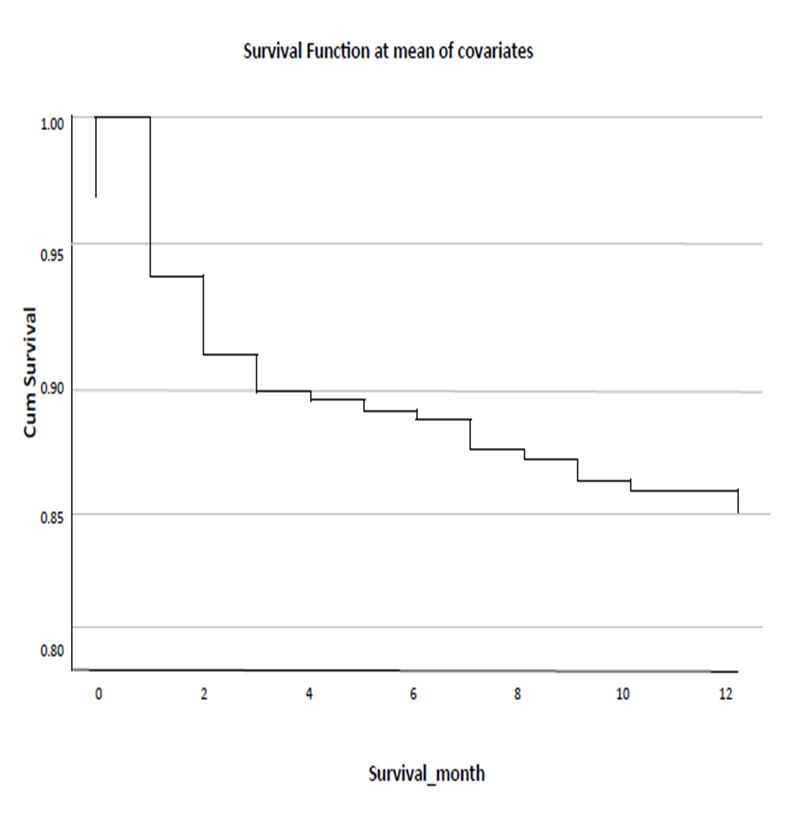
Results: Within one year, 24.3% of ESKD patients died. The mean survival time was 9.74 months (95% CI: 9.15–10.33). Multivariate analysis identified age ≥55 years (p=0.043), non-compliance with nephrology follow-up (p<0.001), haemoglobin ≤8 g/dL (p=0.023), and BUN ≥183.5 mg/dL (p<0.001) as independent predictors of mortality.
Conclusions: Older age, poor compliance, anemia, and elevated BUN were significant predictors of one-year mortality in ESKD patients. Early identification and management of these factors are essential to reduce mortality and improve patient care.

This work is licensed under a Creative Commons Attribution-NonCommercial 4.0 International License.
Authors who publish with this journal agree to the following terms:Authors retain copyright and grant the journal right of first publication with the work simultaneously licensed under a Creative Commons Attribution-NonCommercial 4.0 International License that allows others to share the work with an acknowledgement of the work's authorship and initial publication in this journal.
Authors are able to enter into separate, additional contractual arrangements for the non-exclusive distribution of the journal's published version of the work (e.g., post it to an institutional repository or publish it in a book), with an acknowledgement of its initial publication in this journal.
Authors are permitted and encouraged to post their work online (e.g., in institutional repositories or on their website) prior to and during the submission process, as it can lead to productive exchanges, as well as earlier and greater citation of published work (See The Effect of Open Access).
This work is licensed under a Creative Commons Attribution-NonCommercial 4.0 International License.