In vivo study on the effect of noni leaf extract cream (Morinda Citrifolia L) on PDGF and TNF-α levels in cut wounds

Downloads
ABSTRACT
Background: Skin wounds damage the structure and epithelial tissue, resulting in scar tissue formation. Prolonged wound healing or excessive body response will inhibit the normal process and produce unaesthetic scar tissue. Many plant extracts and their active components can accelerate the wound healing process, Noni leaf extract has antioxidant activity and accelerates wound healing.
Objective: This study aims to determine the effect of noni leaf extract cream (Morinda Citrifolia L) on TNF-α and PDGF levels in Wistar rats with incised wounds.
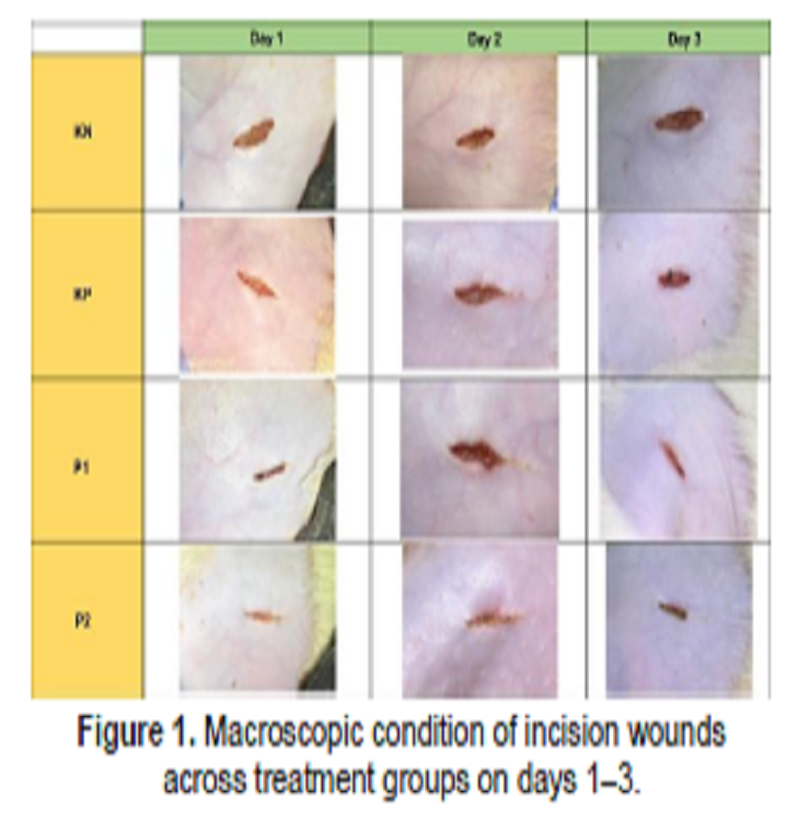
Method: A laboratory experimental study with a post-test only control group design. Consisting of five treatment groups, namely the healthy rat group (KS), Negative group (KN) rats with incised wounds without treatment, positive group (KP) rats with incised wounds that were smeared with povidone-iodine cream, treatment group 1 (P1) rats that were smeared with 20% noni leaf extract cream, and treatment group 2 (P2) rats that were smeared with 40% noni leaf extract cream, treatment for 3 days then examined the levels of TNF-α and PDGF skin tissue using the ELISA method.
Results: The average TNF-α levels showed a significant difference between groups p of 0.000 (p <0.05) with the One way anova test, the highest average in group (KN) 220.68 pg / mL, there was a decrease in all treatment groups with the lowest TNF-α levels in group (KP) 76.59 pg / mL. The average results of TNF-α levels showed a significant difference of p 0.000 (<0.05) with the One-way ANOVA test, the group without intervention (KP) had the lowest PDGF levels while the group (P2) experienced the highest increase in PDGF levels.
Conclusion: Administration of noni leaf extract cream with doses of 20% and 40% had an effect on reducing TNF-α levels and increasing PDGF levels in Wistar rats with incised wounds.
REFERENCES
1. Jourdan M, Madfes DC, Lima E, Tian Y, Seité S. Skin care management for medical and aesthetic procedures to prevent scarring. Clin Cosmet Investig Dermatol. 2019;12:799-804. doi:10.2147/CCID.S218134
2. Prastika DD, Setiawan B, Saputro AL, Yudaniayanti IS, Wibawati PA, Fikri F. Pengaruh Kitosan Udang Secara Topikal Terhadap Kepadatan Kolagen dalam Penyembuhan Luka Eksisi pada Tikus Putih. Jurnal Medik Veteriner. 2020;3(1):101. doi:10.20473/jmv.vol3.iss1.2020.101-107
3. Sorg H, Tilkorn DJ, Hager S, Hauser J, Mirastschijski U. Skin Wound Healing: An Update on the Current Knowledge and Concepts. European Surgical Research. 2017;58(1-2):81-94. doi:10.1159/000454919
4. Pal M, Saxena R, Kanya R, et al. A Detailed Analysis of Herbal Cosmetics. NeuroQuantology. ;20(15):6367. Published online 2022. doi:10.48047/NQ.2022.20.15.NQ88637
5. Ly HT, Pham Nguyen MT, Nguyen TKO, Bui TPQ, Ke X, Le VM. Phytochemical Analysis and Wound-Healing Activity of Noni (Morinda Citrifolia) Leaf Extract. J Herbs Spices Med Plants. 2020;26(4):379-393. doi:10.1080/10496475.2020.1748159
6. Pazyar N, Yaghoobi R, Rafiee E, Mehrabian A, Feily A. Skin wound healing and phytomedicine: A review. Skin Pharmacol Physiol. 2014;27(6):303-310. doi:10.1159/000357477
7. Abou Assi R, Darwis Y, Abdulbaqi IM, khan AA, Vuanghao L, Laghari MH. Morinda citrifolia (Noni): A comprehensive review on its industrial uses, pharmacological activities, and clinical trials. Arabian Journal of Chemistry. 2017;10(5):691-707. doi:10.1016/j.arabjc.2015.06.018
8. Irfayanti NA, Hasan T, Mazriatii M. UJI AKTIVITAS ANTIOKSIDAN EKSTRAK ETANOL DAUN MENGKUDU ( Morinda citrifolia L ) DENGAN METODE DPPH UJI AKTIVITAS ANTIOKSIDAN EKSTRAK ETANOL DAUN MENGKUDU ( Morinda citrifolia L ) DENGAN METODE DPPH. Journal of Pharmaceutical Science and Herbal Technology. 2023;1 (1)(1):5-9.
9. Erliani Mugita Sari D, Happy Ernanda T, Studi Farmasi P, Tinggi Ilmu Kesehatan Cendekia Utama Kudus S. Uji aktivitas antioksidan krim ekstrak daun mengkudu ( Morinda citrifolia L.) berbasis vanishing cream. Jurnal Ilmiah Jophus : Journal of Pharmacy UMUS. 2021;03(01):10-18.
10. Haestidyatami VL, Sugiritama IW, Linawati NM. Pengaruh ekstrak krim Morinda citrifolia terhadap jumlah fibroblas pada penyembuhan luka tikus Wistar. Intisari Sains Medis. 2019;10(3). doi:10.15562/ism.v10i3.487
11. Pereira LDP, Mota MRL, Brizeno LAC, et al. Modulator effect of a polysaccharide-rich extract from Caesalpinia ferrea stem barks in rat cutaneous wound healing: Role of TNF-α, IL-1β, NO, TGF-β. J Ethnopharmacol. 2016;187:213-223. doi:10.1016/j.jep.2016.04.043
12. Trieu LH, Quynh DNN, Oanh NTK, et al. Wound-healing potential of topical application of preparations from Noni (Morinda citrifolia L.) leaf extract. Indian J Nat Prod Resour. 2023;14(2):255-269. doi:10.56042/ijnpr.v14i2.4210
13. Dewi Puspitasari V, Lestari ES, Pramono N. Testosterone Induced Wistar Rat Model for Gut Microbiota Dysbiosis of Polycystic Ovarian Syndrome Research. Journal Of The Indonesian Medical Association. 2024;74(3):132-140. doi:10.47830/jinma-vol.74.3-2024-1461
14. Ritsu M, Kawakami K, Kanno E, et al. Critical role of tumor necrosis factor-α in the early process of wound healing in skin. Journal of Dermatology & Dermatologic Surgery. Published online 2017:(1):14-9.
15. Putra A, Alif I, Hamra N, et al. MSC-Released TGF-β Regulate α-SMA Expression of Myofibroblast during Wound Healing. Journal of Stem Cells & Regenerative Medicine.; 2020.
16. Kumar T, Malik R, Zahrah Maqbool S. Herbal plant with potensial of wound healing activity: a review article. www.wjpps.com │. 2015;12:333. doi:10.20959/wjpps20233-24260
17. Bigliardi PL, Alsagoff SAL, El-Kafrawi HY, Pyon JK, Wa CTC, Villa MA. Povidone iodine in wound healing: A review of current concepts and practices. International Journal of Surgery. 2017;44:260-268. doi:10.1016/j.ijsu.2017.06.073
18. Xiao S, Huang G, Wei Z, et al. IL-10 Gene-modified human amniotic mesenchymal stem cells augment regenerative wound healing by multiple synergistic effects. Stem Cells Int. 2019;2019. doi:10.1155/2019/9158016
19. MacLeod AS, Mansbridge JN. The Innate Immune System in Acute and Chronic Wounds. Adv Wound Care (New Rochelle). 2016;5(2):65-78. doi:10.1089/wound.2014.0608
20. Rohman A, Riyanto S, Hidayati NK. AKTIVITAS ANTIOKSIDAN, KANDUNGAN FENOLIK TOTAL, DAN FLAVONOID TOTAL DAUN MENGKUDU (Morinda citrifolia L). Agritech. 2007;27(4):147-151.
21. Pertiwi R, Manaf S, Supriati R, Saputra HM, Ramadhanti F. Pengaruh Pemberian Salep Kombinasi Ekstrak Daun Morinda citrifolia dan Batang Euphorbia tirucalli terhadap Penyembuhan Luka. Jurnal Farmasi Dan Ilmu Kefarmasian Indonesia. 2020;7(1):42. doi:10.20473/jfiki.v7i12020.42-50
22. Halimah H, Margi Suci D, Wijayanti I. Study of the Potential Use of Noni Leaves (Morinda citrifolia L.) as an Antibacterial Agent for Escherichia coli and Salmonella typhimurium. Jurnal Ilmu Pertanian Indonesia. 2019;24(1):58-64. doi:10.18343/jipi.24.1.58
23. Jian K, Yang C, Li T, et al. PDGF-BB-derived supramolecular hydrogel for promoting skin wound healing. J Nanobiotechnology. 2022;20(1):1-10. doi:10.1186/s12951-022-01390-0
24. HS Z, Putra A. Peran Mesenchymal Stem Cells dalam Regulasi PDGF dan Sel Islet pada Diabetes. Jurnal Kedokteran Brawijaya. 2018;30(2):98-102. doi:10.21776/ub.jkb.2018.030.02.4
25. Das S, Majid M, Baker AB. Syndecan-4 enhances PDGF-BB activity in diabetic wound healing. Acta Biomater. 2016;42:56-65. doi:10.1016/j.actbio.2016.07.001
26. Folestad E, Kunath A, Wågsäter D. PDGF-C and PDGF-D signaling in vascular diseases and animal models. Mol Aspects Med. 2018;62:1-11. doi:10.1016/j.mam.2018.01.005
27. Sabirin IPR, Yuslianti ER. Effect of Topical Noni (Morinda citrifolia L.) Leaf Extract Paste in Carrageenan-induced Paw Edema on Wistar Rats. Global Medical & Health Communication (GMHC). 2019;7(2):116-122. doi:10.29313/gmhc.v7i2.4087
Copyright (c) 2025 MEDISAINS

This work is licensed under a Creative Commons Attribution-NonCommercial 4.0 International License.
Authors who publish with this journal agree to the following terms:Authors retain copyright and grant the journal right of first publication with the work simultaneously licensed under a Creative Commons Attribution-NonCommercial 4.0 International License that allows others to share the work with an acknowledgement of the work's authorship and initial publication in this journal.
Authors are able to enter into separate, additional contractual arrangements for the non-exclusive distribution of the journal's published version of the work (e.g., post it to an institutional repository or publish it in a book), with an acknowledgement of its initial publication in this journal.
Authors are permitted and encouraged to post their work online (e.g., in institutional repositories or on their website) prior to and during the submission process, as it can lead to productive exchanges, as well as earlier and greater citation of published work (See The Effect of Open Access).
This work is licensed under a Creative Commons Attribution-NonCommercial 4.0 International License.