Factors affecting resilience of drug abusers at correctional facilities

Downloads
Background: Indonesia is currently facing a narcotics emergency as indicated by a drastic increase in the number of drug users and drug-related deaths. Rehabilitation does not guarantee recovery and relief from drugs. Even while undertaking rehabilitation, drug abusers may relapse. Resilience can prevent drug abusers from relapsing and help them overcome their problems. There has been a dearth of research focusing on factors affecting the resilience of drug abusers in Indonesia.
Objective: The objective of this research is to identify factors affecting the resilience of drug abusers at correctional facilities in the Special Region of Yogyakarta.
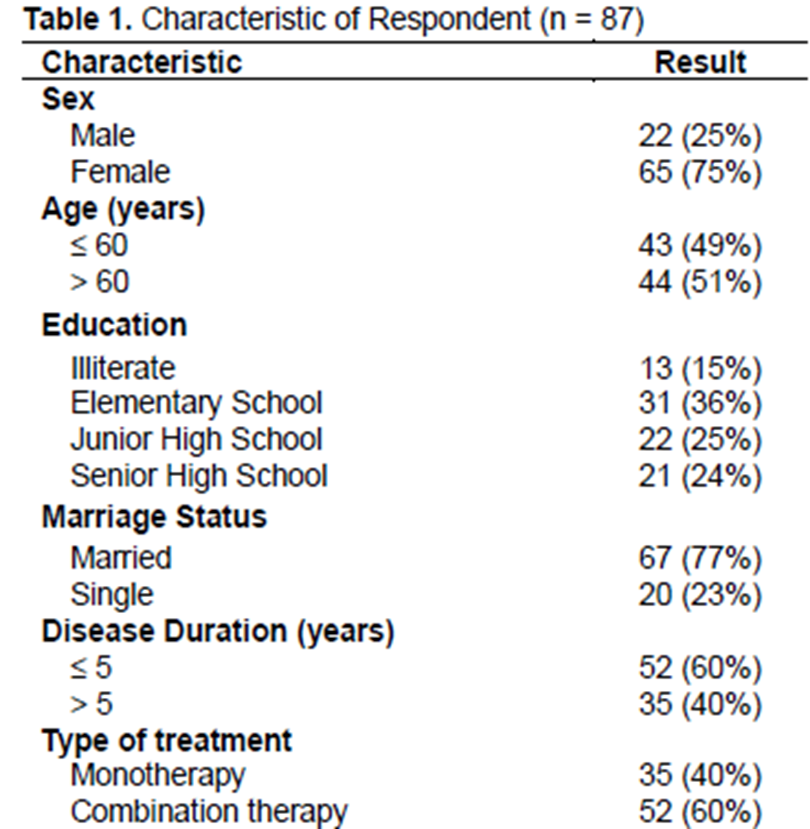
Methods: This is a cross-sectional design and was conducted in February 2017 at the Correctional Facility for Narcotics Cases Class IIA in Sleman and the Correctional Facility in Wirogunan. A total of 77 respondents were involved in this research by a consecutive sampling technique. The instruments used included the resilience questionnaire developed by Pertiwi based on Grotberg’s theory, Beck Depression Inventory II, Satis-faction with Life Scale and Positive Affect Negative Affect Schedule, Isundariyana’s stress instrument, Rosenberg Self-Esteem Scale (RSES), Zung Self Rating Anxiety Scale (ZSAS), General Self-Efficacy Scale, Life Orientation Test-Revised (LOT-R), and Difficulties in Emotion Regulation Scale (DERS). The data were analyzed by univariate, bivariate (Pearson and Spearman’s Rank), and multivariate (linear regression) analyses.
Results: Out of the 8 factors examined (subjective well-being, optimism, self-esteem, emotion regulation, anxiety, stress, depression, and self-efficacy) and 2 demographic factors (age and occupational status), only self-efficacy (β = 1.063; p = 0.13), optimism (β = 1.51; p = 0.01), and self-esteem (β = 1.540; p = 0.009) affected resilience.
Conclusions: Self-efficacy, optimism, and self-esteem are modifiable factors that can influence the resilience of drug abusersAuthors retain copyright and grant the journal right of first publication with the work simultaneously licensed under a Creative Commons Attribution-NonCommercial 4.0 International License that allows others to share the work with an acknowledgement of the work's authorship and initial publication in this journal.
Authors are able to enter into separate, additional contractual arrangements for the non-exclusive distribution of the journal's published version of the work (e.g., post it to an institutional repository or publish it in a book), with an acknowledgement of its initial publication in this journal.
Authors are permitted and encouraged to post their work online (e.g., in institutional repositories or on their website) prior to and during the submission process, as it can lead to productive exchanges, as well as earlier and greater citation of published work (See The Effect of Open Access).

This work is licensed under a Creative Commons Attribution-NonCommercial 4.0 International License.