In vivo study of Centella asiatica (L.) Urban as a drug gel for diabetes wounds

Downloads
Background: Centella asiatica L. Urban is a tropical plant whose spread is quite broad as Indonesia. One of the ingredients of Centella asiatica L. Urban is asiaticoside which has excellent wound healing abilities. However, research on diabetic wound healing with Centella asiatica L. Urban extract formulation in the form of a gel has not been found. Therefore, it is necessary to look at the healing activity of diabetic wounds using Centella asiatica L. Urban extract in the form of a gel.
Objective: This experimental study aims to explore the effect of gel extract derived from the Centella asiatica L. Urban on the length of time for wound healing.
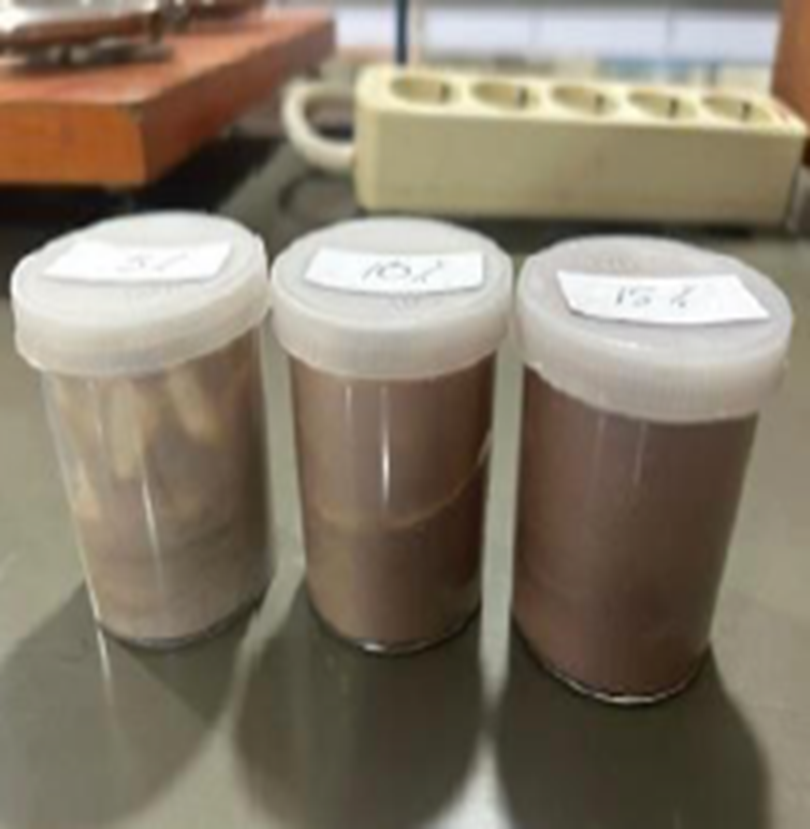
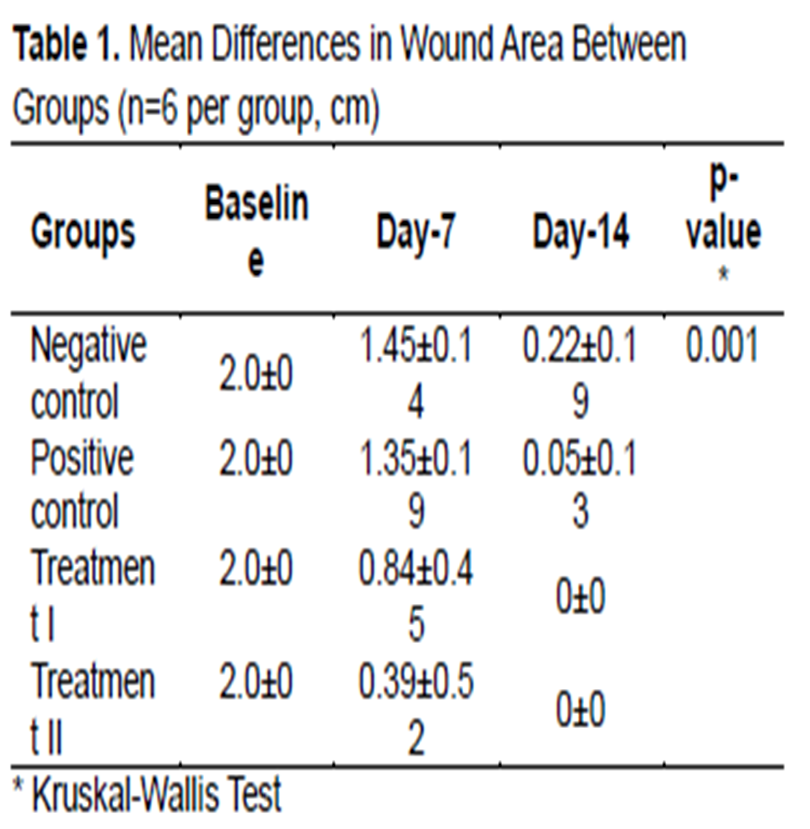
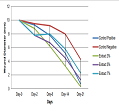
Methods: The subjects in this study were eight weeks old Balb-C mice conditioned to hyperglycemia and were divided into five groups. The Centella asiatica L. Urban extract is provided in three concentration levels, with 3%, 5%, and 7%. As a form of negative control, used gel without Centella asiatica L. Urban extract and positive control without gel, only hydrocolloid dressing.
Results: Centella asiatica L. Urban at concentrations of 3% (with the value of Sig. > 0.05), 5%, and 7% showed the ability to heal wounds.
Conclusions: Centella asiatica L. Urban gel extract with a concentration of 3% had a significant effect on wound healing compared to other preparations.Authors retain copyright and grant the journal right of first publication with the work simultaneously licensed under a Creative Commons Attribution-NonCommercial 4.0 International License that allows others to share the work with an acknowledgement of the work's authorship and initial publication in this journal.
Authors are able to enter into separate, additional contractual arrangements for the non-exclusive distribution of the journal's published version of the work (e.g., post it to an institutional repository or publish it in a book), with an acknowledgement of its initial publication in this journal.
Authors are permitted and encouraged to post their work online (e.g., in institutional repositories or on their website) prior to and during the submission process, as it can lead to productive exchanges, as well as earlier and greater citation of published work (See The Effect of Open Access).

This work is licensed under a Creative Commons Attribution-NonCommercial 4.0 International License.