Patterns and predictors of anaemia in haemodialysis patients: relationship with comorbidities and dialysis exposure time

Downloads
Background: Anaemia is a common and serious complication in patients with chronic kidney disease (CKD) undergoing haemodialysis, contributing to increased morbidity, mortality, and reduced quality of life. Its prevalence and predictors vary across populations, and evidence from Indonesian cohorts remains limited.
Objective: This study aimed to investigate the prevalence, severity, and predictors of anaemia in haemodialysis patients, with a particular focus on the influence of comorbidities and dialysis duration.
Methods: A cross-sectional analytic study was conducted among 71 CKD patients undergoing regular haemodialysis at Kenak Medika Ubud Hospital between July and August 2024. Data on demographics, dialysis duration, comorbidities, and laboratory parameters (Hb, BUN, SC, MCV, MCH) were extracted from medical records. Anaemia severity was classified according to WHO and KDIGO guidelines. Statistical analysis included descriptive statistics, Chi-square tests, ANOVA, correlation analysis, and multivariate linear regression.
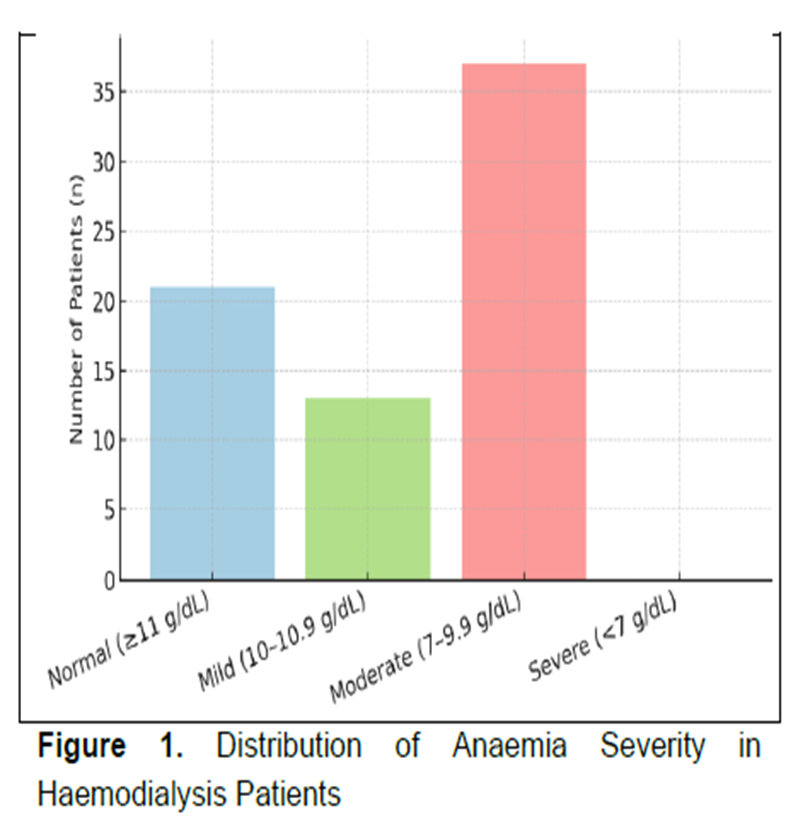
Results: The prevalence of anaemia was 70.4%, with moderate anaemia being the most common presentation (52.1%). Patients with dialysis duration >24 months had significantly lower haemoglobin levels compared to those with shorter treatment exposure (p = 0.014). Multivariate regression analysis identified hypertension (p = 0.009) and cardiovascular disease (p = 0.013) as significant predictors of haemoglobin levels, while diabetes mellitus, BUN, SC, MCV, and MCH showed no significant associations.
Conclusion: Anaemia remains highly prevalent in haemodialysis patients, with dialysis duration and cardiovascular comorbidities emerging as key predictors. These findings underscore the importance of routine anaemia monitoring, individualized treatment strategies, and integrated management of cardiovascular comorbidities to optimize outcomes in haemodialysis populations.
1. Badura K, Janc J, Wąsik J, et al. Anemia of Chronic Kidney Disease—A Narrative Review of Its Pathophysiology, Diagnosis, and Management. Biomedicines. 2024;12(6):1191. doi:10.3390/biomedicines12061191
2. Batchelor EK, Kapitsinou P, Pergola PE, Kovesdy CP, Jalal DI. Iron Deficiency in Chronic Kidney Disease: Updates on Pathophysiology, Diagnosis, and Treatment. Journal of the American Society of Nephrology. 2020;31(3):456-468. doi:10.1681/ASN.2019020213
3. Portolés J, Martín L, Broseta JJ, Cases A. Anemia in Chronic Kidney Disease: From Pathophysiology and Current Treatments, to Future Agents. Front Med (Lausanne). 2021;8:642296. doi:10.3389/fmed.2021.642296
4. Ferdina CS, Vardila Putri NP, - L. Development of Interactive Educational Media for Preventing Anemia in Teenage Girl Based on E-Flipbooks as An Effort to Accelerate Stunting Reduction. International Journal of Nursing and Midwifery Science (IJNMS). 2023;7(3):401-406. doi:10.29082/IJNMS/2023/Vol7/Iss3/538
5. Bissinger R, Nemkov T, D’Alessandro A, et al. Proteinuric chronic kidney disease is associated with altered red blood cell lifespan, deformability and metabolism. Kidney Int. 2021;100(6):1227-1239. doi:10.1016/j.kint.2021.08.024
6. Rahman Z, Khariroh S, Abdi F. Kualitas hidup pasien gagal ginjal kronik dengan komorbid diabetes melitus dan hipertensi yang menjalani hemodialisa. Menara Medika. 2022;5(1):121-127.
7. KDIGO Anemia Work Group. KDIGO Clinical Practice Guideline for Anemia in Chronic Kidney Disease. Kidney Int Suppl (2011). 2012;2(4):279-335.
8. Hakim L, Maslachah L, Sunarjo S. Prevalensi anemia pada penderita penyakit ginjal kronik yang menjalani hemodialisis reguler. Jurnal Kedokteran Brawijaya. Jurnal Kedokteran Brawijaya. 2016;29(2):114-119.
9. Puspitaningrum D, Indrayani UD, Syaifuddin S. Analisis faktor-faktor yang mempengaruhi kejadian anemia pada pasien gagal ginjal kronik yang menjalani hemodialisis. Jurnal Keperawatan Soedirman. 2016;11(2):78-87.
10. Akizawa T, Okumura H, Alexandre AF, Fukushima A, Kiyabu G, Dorey J. Burden of Anemia in Chronic Kidney Disease Patients in Japan: A Literature Review. Therapeutic Apheresis and Dialysis. 2018;22(5):444-456. doi:10.1111/1744-9987.12712
11. Akchurin O, Patino E, Dalal V, et al. Interleukin-6 Contributes to the Development of Anemia in Juvenile CKD. Kidney Int Rep. 2019;4(3):470-483. doi:10.1016/j.ekir.2018.12.006
12. Wojtaszek E, Glogowski T, Malyszko J. Iron and Chronic Kidney Disease: Still a Challenge. Front Med (Lausanne). 2020;7. doi:10.3389/fmed.2020.565135
13. Mohtar AA, Nugraha GI, Decroli E. Prevalensi dan faktor risiko anemia pada pasien penyakit ginjal kronik yang menjalani hemodialisis. Jurnal Kesehatan Andalas. 2022;11(1):158-164.
14. Toft G, Heide-Jørgensen U, van Haalen H, et al. Anemia and clinical outcomes in patients with non-dialysis dependent or dialysis dependent severe chronic kidney disease: a Danish population-based study. J Nephrol. 2020;33(1):147-156. doi:10.1007/s40620-019-00652-9
15. Kang SH, Kim BY, Son EJ, Kim GO, Do JY. Association between Iron Status and Survival in Patients on Chronic Hemodialysis. Nutrients. 2023;15(11):2577. doi:10.3390/nu15112577
16. Babitt JL, Lin HY. Mechanisms of Anemia in CKD. Journal of the American Society of Nephrology. 2012;23(10):1631-1634. doi:10.1681/ASN.2011111078
17. Lopez A, Cacoub P, Macdougall IC, Peyrin-Biroulet L. Iron deficiency anaemia. The Lancet. 2016;387(10021):907-916. doi:10.1016/S0140-6736(15)60865-0
18. Coyne DW, Roger SD, Shin SK, et al. Roxadustat for CKD-related Anemia in Non-dialysis Patients. Kidney Int Rep. 2021;6(3):624-635. doi:10.1016/j.ekir.2020.11.034
Copyright (c) 2025 MEDISAINS

This work is licensed under a Creative Commons Attribution-NonCommercial 4.0 International License.
Authors who publish with this journal agree to the following terms:Authors retain copyright and grant the journal right of first publication with the work simultaneously licensed under a Creative Commons Attribution-NonCommercial 4.0 International License that allows others to share the work with an acknowledgement of the work's authorship and initial publication in this journal.
Authors are able to enter into separate, additional contractual arrangements for the non-exclusive distribution of the journal's published version of the work (e.g., post it to an institutional repository or publish it in a book), with an acknowledgement of its initial publication in this journal.
Authors are permitted and encouraged to post their work online (e.g., in institutional repositories or on their website) prior to and during the submission process, as it can lead to productive exchanges, as well as earlier and greater citation of published work (See The Effect of Open Access).
This work is licensed under a Creative Commons Attribution-NonCommercial 4.0 International License.