Role of family in the hospitalization of critical patients in the intensive care unit

Downloads
Background: Patients need help from others to meet their needs during hospitalization in the Intensive Care Unit (ICU). The role of the family is significant in the care of critical patients in the ICU because it helps fulfill the satisfaction and providing supportive care of patients related to their intimacy.
Objectives: This study aims to explore the role of families in the hospitalization of critical patients in the ICU.
Method: This study used a qualitative method with a phenomenological approach. Data retrieval is done through in-depth interviews, focused group discussions, and observations. The participant recruitment technique uses pur-posive sampling. The research participants were 24 people and were following with the inclusion criteria. Source triangulation is done to find out the validity of research data and the roles performed by the family. This qualitative data was analyzed using N-Vivo 12 plus methods.
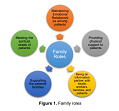
Results: There are five themes accompanied by 12 sub-themes in them, including developing emotional relationships with patients, providing physical support to patients, becoming information partners with health personnel, fami-lies, and patients, supporting patient facilities and infra-structure, families meeting patients' spiritual needs.
Conclusion: Family members are involved in patient care because families are given the opportunity and sufficient time to visit patients. Suggestions for further research can consider the family background in the involvement of roles and factors that influence family roles during hospitalization of patients in the ICU.Authors retain copyright and grant the journal right of first publication with the work simultaneously licensed under a Creative Commons Attribution-NonCommercial 4.0 International License that allows others to share the work with an acknowledgement of the work's authorship and initial publication in this journal.
Authors are able to enter into separate, additional contractual arrangements for the non-exclusive distribution of the journal's published version of the work (e.g., post it to an institutional repository or publish it in a book), with an acknowledgement of its initial publication in this journal.
Authors are permitted and encouraged to post their work online (e.g., in institutional repositories or on their website) prior to and during the submission process, as it can lead to productive exchanges, as well as earlier and greater citation of published work (See The Effect of Open Access).

This work is licensed under a Creative Commons Attribution-NonCommercial 4.0 International License.