Effectiveness of warm herbal compress on oxytocin hormone and breast milk production

Downloads
Background: Breast milk is the best food for babies, needed for optimal growth and development. The lack of milk production influences the low coverage of exclusive breastfeeding. Increasing breast milk production could be done non-pharmacologically, using warm herbal compresses as breast care.
Purpose: Analyze the effect of warm herbal compresses as breast care on oxytocin hormone and postpartum mother's milk production.
Methods: Quasi-experimental design pretest-posttest with the control group, respondents were 36 normal mothers on the third day of postpartum; 18 respondents intervention group, and 18 respondents control group. Warm herbal compresses were provided once per day with 20 minutes on each breast for three days. The oxytocin hormone was measured pre and post three days of treatment, the volume of breast milk was measured pre, post 2, and 3 days of treatment.
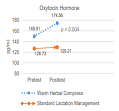
Results: The intervention group's average difference in oxytocin hormone was 24.65 pg/ml, the control group was 2.48 pg/ml (p<0.01). The average increase in milk production pre and post-three days of treatment in the intervention group was 32,250 ml. In the control group, 26,472 ml (p<0.01), there was a significant difference in the average milk production between the two groups.
Conclusion: Warm herbal compresses as breast care affects the oxytocin hormone and postpartum mother's milk production.Authors retain copyright and grant the journal right of first publication with the work simultaneously licensed under a Creative Commons Attribution-NonCommercial 4.0 International License that allows others to share the work with an acknowledgement of the work's authorship and initial publication in this journal.
Authors are able to enter into separate, additional contractual arrangements for the non-exclusive distribution of the journal's published version of the work (e.g., post it to an institutional repository or publish it in a book), with an acknowledgement of its initial publication in this journal.
Authors are permitted and encouraged to post their work online (e.g., in institutional repositories or on their website) prior to and during the submission process, as it can lead to productive exchanges, as well as earlier and greater citation of published work (See The Effect of Open Access).

This work is licensed under a Creative Commons Attribution-NonCommercial 4.0 International License.